The honest answer to "how often should we restripe?" is "when the lines stop doing their job." That sounds like a dodge, but it is the right test. Paint wears at different speeds on different lots, and a calendar date does not tell you much on its own. This guide gives you a practical schedule, explains what makes paint wear faster, and shows you how to check your own lot in five minutes.
The short answer
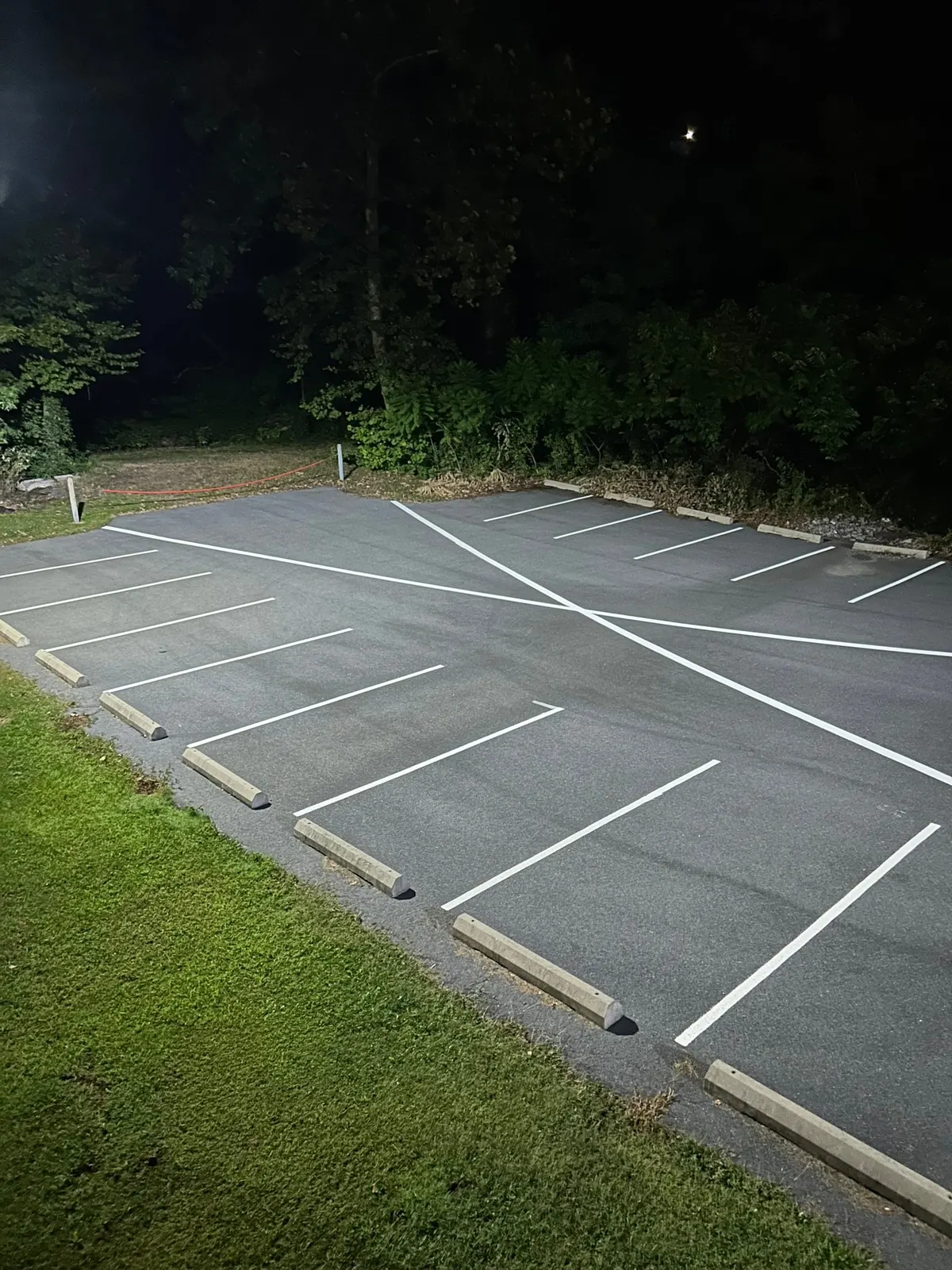
Most commercial parking lots in Lancaster County look best with fresh lines every one to two years. High-traffic lots, such as retail plazas, restaurants, medical offices and churches with big weekly crowds, often need yearly touch ups. Low-traffic lots, such as small offices, can go closer to two years or a little more.
Some parts of the lot wear faster than the rest. Arrows, stop bars, crosswalks and the entry lanes see the most tire contact. Accessible stalls need to stay crisp because they carry legal weight. It is common to touch up those areas more often than the full lot.
What makes paint wear out
Four things decide how long paint lasts.
Traffic
Every tire crossing a line scuffs it a little. A stall in the first row at a busy store sees far more crossings than a stall at the back of a church lot. The paint at the front disappears first.
Weather
Sun fades paint and dries out the binder. Rain washes away loose particles. In Pennsylvania, winters add salt and plow blades, which scrape the surface and are particularly hard on lines near curbs, drive aisles and entrances. Two or three plow seasons can take a crisp line down to a ghost.
Surface condition
Paint grips a clean, sound surface. On a rough, oxidized surface, it wears faster and looks patchy. On an oily or dirty surface, it can peel. Lots with a lot of cracking and patching also lose lines faster, because the paint cracks along with the pavement.
Paint and application
The type of paint matters, as does the way it is applied. Cheap paint wears sooner. Paint applied on a damp surface, or when it is too cold, does not bond well. Lines that are put on too thin disappear quickly. This is one reason a quote that seems unusually low may cost more over time.
How to tell it is time
You do not need a special tool. Walk the lot and check these:
- The 50-foot test. Stand at the far end of a row of stalls. If you cannot clearly see the lines from 50 feet away, they are overdue.
- Wheel-path wear. Look for lines where the paint is worn right through to the asphalt where tires roll.
- ADA stalls. Check that the symbol, the outline and the access aisle hatching are all clearly visible.
- Arrows and stop bars. These wear quickly and are often the first thing to go.
- Crosswalks. Faded crosswalks are a safety problem and worth fixing early.
- Fire lanes and curbs. Check that curb paint and lettering are readable.
- Behavior. If drivers park crooked, straddle lines or ignore stalls, the lot is telling you something.
If three or more of these fail, schedule the work.
Timing it with other work
Restriping is the last step in the sequence, and that matters.
- Crack filling. Fill cracks first so water does not get in. Fall is the best time.
- Pothole and base repair. Fix failed areas so the surface is sound.
- Sealcoating. Seal the surface to protect it.
- Striping. Paint the lines on a clean, cured surface.
If you stripe first and then seal, you cover your fresh lines and have to paint again. If you seal and stripe too close together, the paint may not bond. After sealcoating, give the surface 24 to 48 hours to cure before painting, longer in cool or humid weather. We cover the full order in our parking lot maintenance guide.
A good rule: if the lot is due for sealing, re-stripe at the same time. If it is not due for sealing, you can re-stripe on its own.
When the layout needs to change
Restriping is also a chance to fix problems. Before painting over old lines, ask whether the layout still makes sense.
- Does it match your stall count? If accessible stalls are required and you are short, now is the time.
- Are the ADA stalls close to the entrance? They should be on the shortest accessible route.
- Is the traffic flow clear? Arrows and stop bars help.
- Are there wasted areas? Odd corners can sometimes hold extra stalls.
- Is there a loading zone, fire lane or pickup spot that should be added?
If the layout changes, the old lines need to be blacked out so drivers do not follow ghost markings. We do that as part of the job.
Special cases
A few situations change the usual schedule.
After repaving or a major repair. New asphalt or a large patch needs new lines, but wait until the surface has settled. For fresh paving, lines are usually painted after a cure period, and the layout is a good chance to correct earlier problems.
Apartment communities and HOAs. Numbered stalls, visitor parking and fire lanes matter here, and residents notice when they fade. Plan around move-in seasons and let tenants know the day before so cars are moved.
Seasonal businesses. If your busy season is summer, restripe in spring. If it is the holidays, restripe in early fall. Do it before the crowd arrives, not after.
Multiple tenants. Shared lots need an agreement on who pays and who decides the layout. A written plan avoids arguments about reserved stalls and loading areas.
Schools and churches. The calendar rules. We often work on weekdays at churches and on weekends or school breaks at schools, so the lot is dry and open when people return.
Re-striping a small lot versus a large one
The principles are the same, but the scheduling is different.
Small lots can be done in a few hours. The challenge is usually keeping cars out of the work area. We can work early or after hours.
Large lots can take a day or more. We work in sections so part of the lot stays open, and we schedule around peak hours. For retail and restaurants, that often means nights or early mornings.
What it costs
Striping is one of the least expensive services in pavement maintenance. In Lancaster County, a re-stripe over existing lines typically runs $4 to $6 per stall, and a new layout from scratch runs $8 to $12 per stall. ADA symbols are $25 to $45 each, and arrows are $15 to $30. Our minimum job is $400. See what Lancaster businesses actually pay for parking lot striping for more.
Mistakes to avoid
- Waiting until the lines are gone. Re-striping over faint lines is easier and cheaper than starting from scratch.
- Painting over a dirty surface. The paint peels. A good crew sweeps and cleans first.
- Skipping the layout check. You may be repeating an old mistake.
- Painting right after sealcoating. Let the sealer cure first.
- Choosing by price alone. Thin paint and fast work wear out quickly.
We listed more in 10 parking lot striping mistakes that make your business look bad.
A simple annual schedule
Here is a plan that works for many commercial properties.
- Spring. Walk the lot after winter. Note potholes, plow damage and worn lines.
- Late spring to summer. Repair, seal if due, then re-stripe.
- Early fall. Fill cracks before winter.
- Every year. Touch up accessible stalls, arrows and crosswalks.
- Every one to two years. Full re-stripe.
Frequently asked questions
Can I re-stripe in cold weather?
Paint needs a dry surface and temperatures above roughly 50 degrees to bond properly. In Pennsylvania, that means spring through fall.
Should the lines be white or yellow?
Parking stalls are usually white or yellow, depending on your preference or the existing lot. Many properties use yellow for curbs and fire lanes and white for stalls, with blue for accessible stalls. We follow what you have or help you choose.
How long does the paint take to dry?
Traffic paint is typically dry to the touch within an hour in good conditions. We keep the area coned off until it is safe, and most lots reopen the same day.
How do I know the job was done right?
Lines should be straight, consistent in width and cleanly started and stopped. Stencils should be square and centered. ADA stalls should be measured and match the required dimensions. Ask us to walk it with you.
Do I need to close my business?
Usually not. We work around your hours and in sections.
Plan your next re-stripe
If your lot is overdue, or you want to know when it will be, send us the address and a few photos. We will tell you what it needs and give you a written price. See our parking lot striping page or request a free quote.