There’s a pothole on your street that’s been “fixed” three times. You’ve watched it happen: a truck pulls up, somebody shovels black stuff into the hole, taps it twice, and leaves. By March, the hole is back, same spot, bigger appetite. If you’re wondering whether pothole repairs are just a subscription service you never signed up for, they’re not. Potholes come back because of how they’re filled, not because asphalt is cursed. Here’s the actual asphalt pothole repair process we use, every step, in order, and why each one is the reason our patches are still there years later.
Why Most Pothole Repairs Fail (The “Throw-and-Go” Problem)
The repair you watched fail three times has a name in the industry: throw-and-go. Cold patch material gets thrown into the hole, along with whatever water, dirt, and loose gravel already lived there, and traffic is expected to do the compacting. The Federal Highway Administration has studied patching methods for decades, and even they classify throw-and-go as a temporary, emergency-only technique. It exists so a road crew can make forty holes safe before lunch in January. It was never meant to be the final repair.
Here’s why it fails. The patch sits in a bowl with crumbling edges, on top of a soggy base, with air pockets all through it. Water gets in from the sides, from below, and straight through the top. Then a Lancaster County winter runs it through dozens of freeze-thaw cycles, water freezing and expanding about 9 percent each time, and the patch pops out like a cork. The hole didn’t come back. It never actually left.
A permanent repair does five things the throw-and-go skips. Let’s walk through them.
Step 1: Square-Cut the Edges Back to Healthy Asphalt
A pothole’s edges are a lie. The visible rim is surrounded by asphalt that looks fine but is cracked, undermined, and ready to crumble. Patch up to a rotten edge and you’ve bonded your new asphalt to material that’s about to fail, which means your patch fails with it.
So the first real step is cutting. We saw or mill the hole into a clean shape with vertical faces, think of a dentist drilling out the soft part of a cavity before filling it. Nobody loves the dentist metaphor, but it’s accurate: fill a cavity without removing the decay and you’ll be back in that chair. We cut until we hit sound, solid asphalt on every side, even when that means the repair gets a little bigger than the hole looked. Vertical faces also give the new asphalt something to press against during compaction, which matters enormously in a minute.
Step 2: Fix What’s Underneath (Because the Hole Started There)
Potholes aren’t really a surface problem. By the time asphalt collapses into a hole, the stone base underneath has usually been saturated, churned, and washed around by water. Pour new asphalt over a failed base and you’ve built a floor over a sinkhole.
Once the hole is cut clean, we dig out everything loose and wet, old patch material, mud, rounded gravel, down to material that’s actually solid. Then we rebuild: fresh stone base, compacted hard, brought back up to the right depth. On a shallow surface failure this step is quick. On a hole that’s been drinking runoff for two winters, it’s most of the job. It’s also the single biggest difference between a $50 patch and a repair that holds, which we break down in our post on what pothole repair costs in Lancaster.
Step 3: Tack Coat, The Glue Nobody Sees
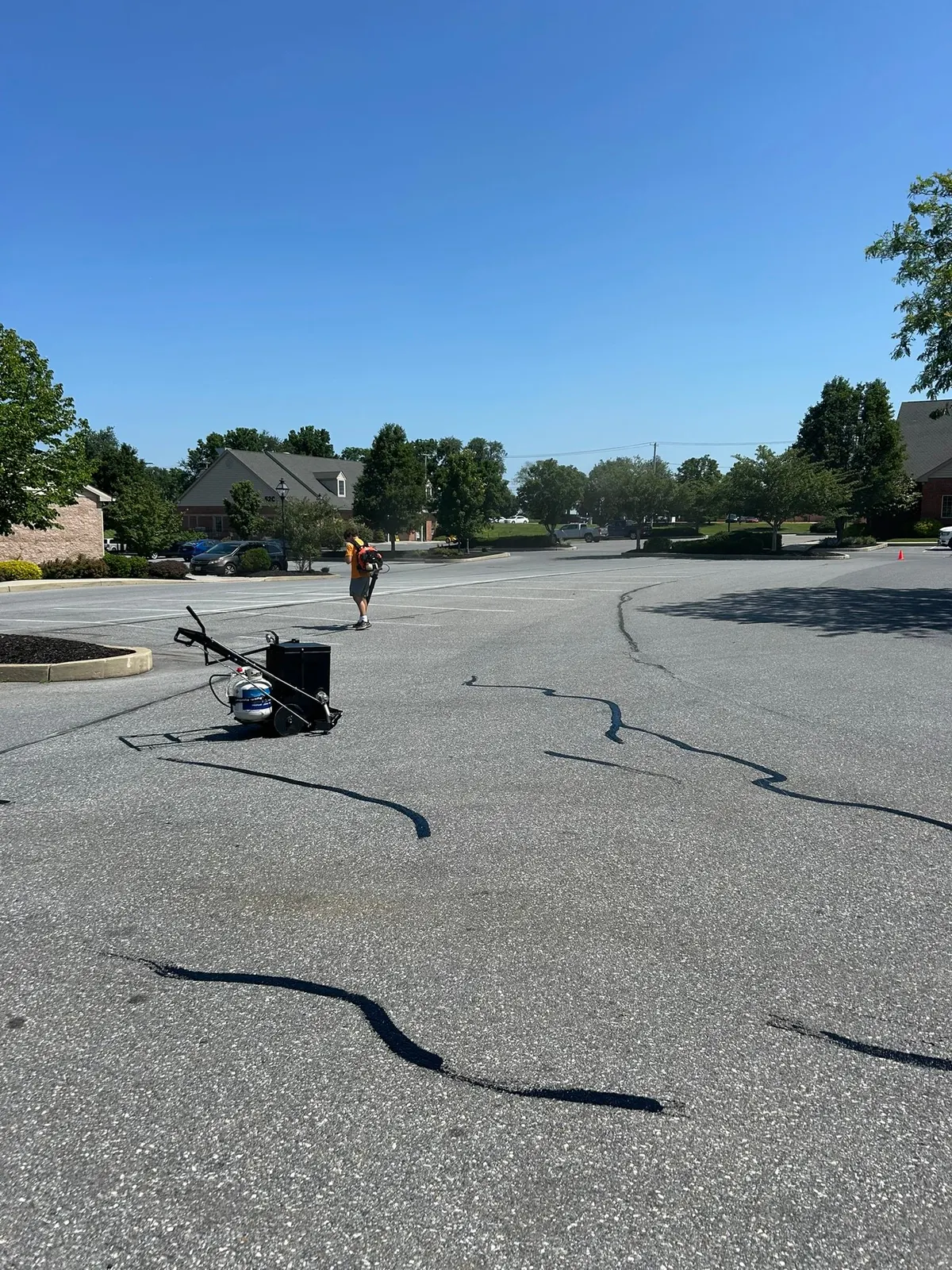
New asphalt doesn’t automatically weld itself to old asphalt. Before the hot mix goes in, we coat the cut faces and the bottom of the repair with tack, a sticky asphalt emulsion that acts as the bonding agent between old pavement and new. Skip it, and you get a patch that’s merely sitting in the hole, with a hairline seam around it that water finds by roughly Tuesday. The Asphalt Institute is emphatic about bonding layers for exactly this reason: most patch failures start at the seam, and tack is what closes the seam.
Step 4: Hot Mix, Placed in Lifts, Not Dumped in a Pile
Now the part everyone pictures: the asphalt. We use hot mix, the same 300°F material your driveway was built from, not bagged cold patch. And we don’t fill a deep hole in one glorious dump, because thick asphalt can’t be compacted properly. The surface tightens up while the middle stays loose, like a brownie that’s raw in the center. Delicious in baking. Disastrous in pavement.
Instead, deep repairs get filled in lifts, layers of a couple of inches at a time, each one compacted before the next goes in. It takes longer. It’s also why our patches don’t sink into a dish six months later. Layered compaction is the boring, unglamorous heart of the whole asphalt pothole repair process.
Step 5: Compact Until It’s Pavement, Then Seal the Seam
Each lift gets compacted with a plate compactor or roller until the density matches the surrounding pavement, this is where those vertical cut faces from Step 1 earn their keep, giving the material something to compress against. The final surface ends up slightly proud, then rolls down flush, so water sheets across the repair instead of pooling on it.
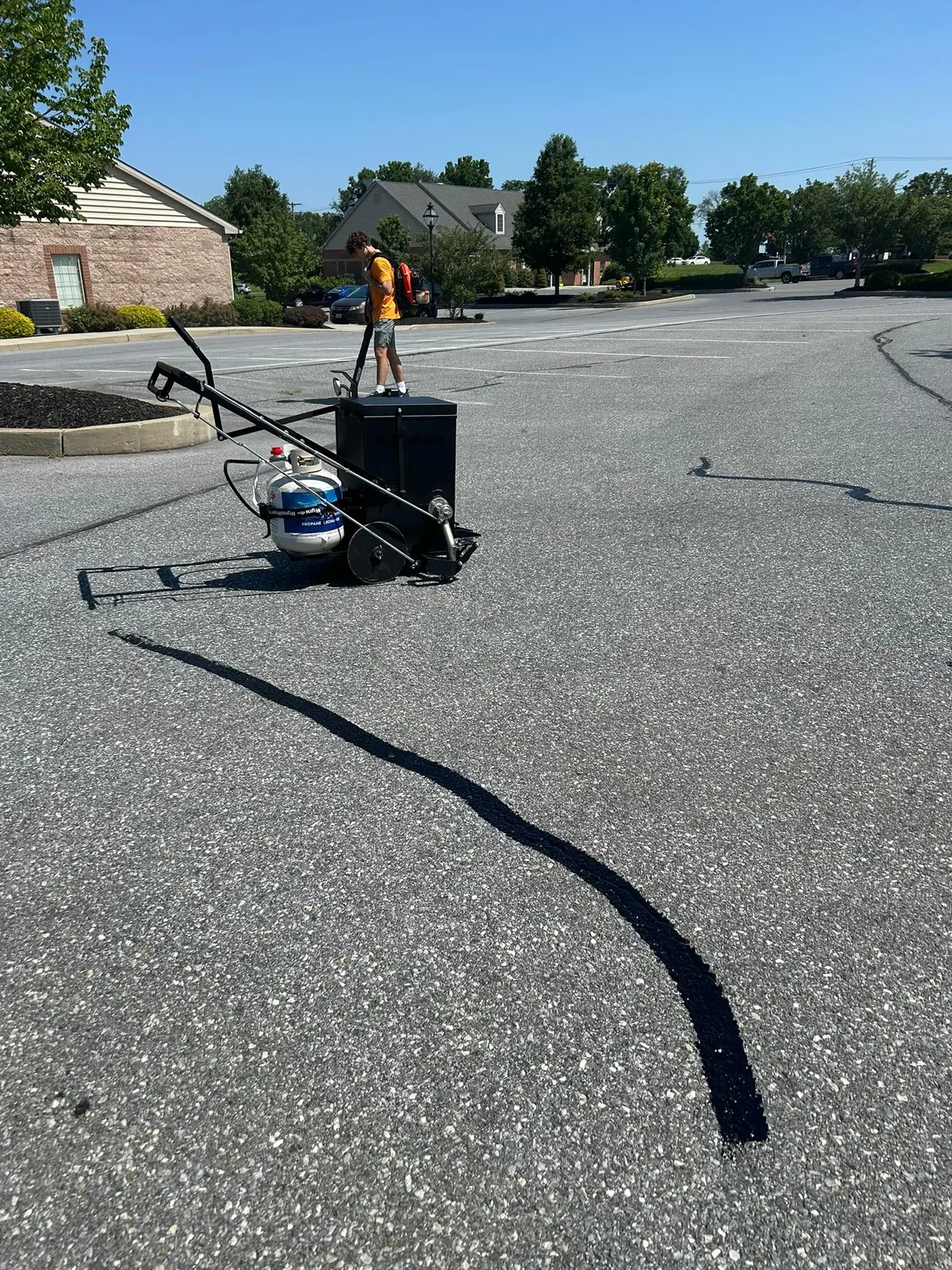
Last touch: the perimeter. Even a perfect patch has a seam where new meets old, and seams are where water applies for entry. We seal that joint the same way we seal cracks, with hot rubberized sealant that stays flexible through winter. It’s the same material and logic behind our crack filling service, and it’s the step that separates “repaired” from “repaired until spring.”
Where Cold Patch Actually Belongs
We’re not cold patch snobs, we carry it on the truck. When a customer calls in February with a hole that’s murdering tires, cold patch is the right call: it works in any temperature, it makes the hole safe today, and it buys time until the asphalt plants open. The difference is we call it what it is, a temporary fill, and we schedule the permanent hot mix repair for spring instead of pretending the bag was the fix. If a contractor quotes you a “permanent” repair in January in Pennsylvania, ask them where they’re getting hot mix. The silence will be educational.
Honest Talk: When a Patch Is the Wrong Answer
Sometimes we look at a driveway and the right advice isn’t “patch it.” If a quarter of the surface is alligatored, sunken, and pocked with holes, patching is just repaving in slow motion at premium prices. In those cases we’ll tell you straight, and our guide to pothole repair vs. full repaving lays out how we make that call.
Same goes for timing. One pothole in an otherwise decent driveway in late fall? It’s often smarter to drop a temporary fill in it and bundle the permanent repair with your spring crack filling and sealcoating, one service call instead of two, and everything from our spring asphalt checklist gets handled in a single visit. We’d rather you spend less and trust us more.
How to Tell If a Patch Was Done Right (From Your Porch)
You don’t need to stand over the crew with a clipboard, a finished patch tells on itself. Here’s what a repair that will last actually looks like:
- Straight, saw-cut edges. A patch shaped like a rectangle was cut on purpose. A patch shaped like an amoeba was poured into whatever hole existed, a bad sign.
- Flush or slightly proud surface. The patch should sit level with the pavement or a hair above it. If it’s already a shallow dish, it wasn’t compacted in lifts and it will keep sinking.
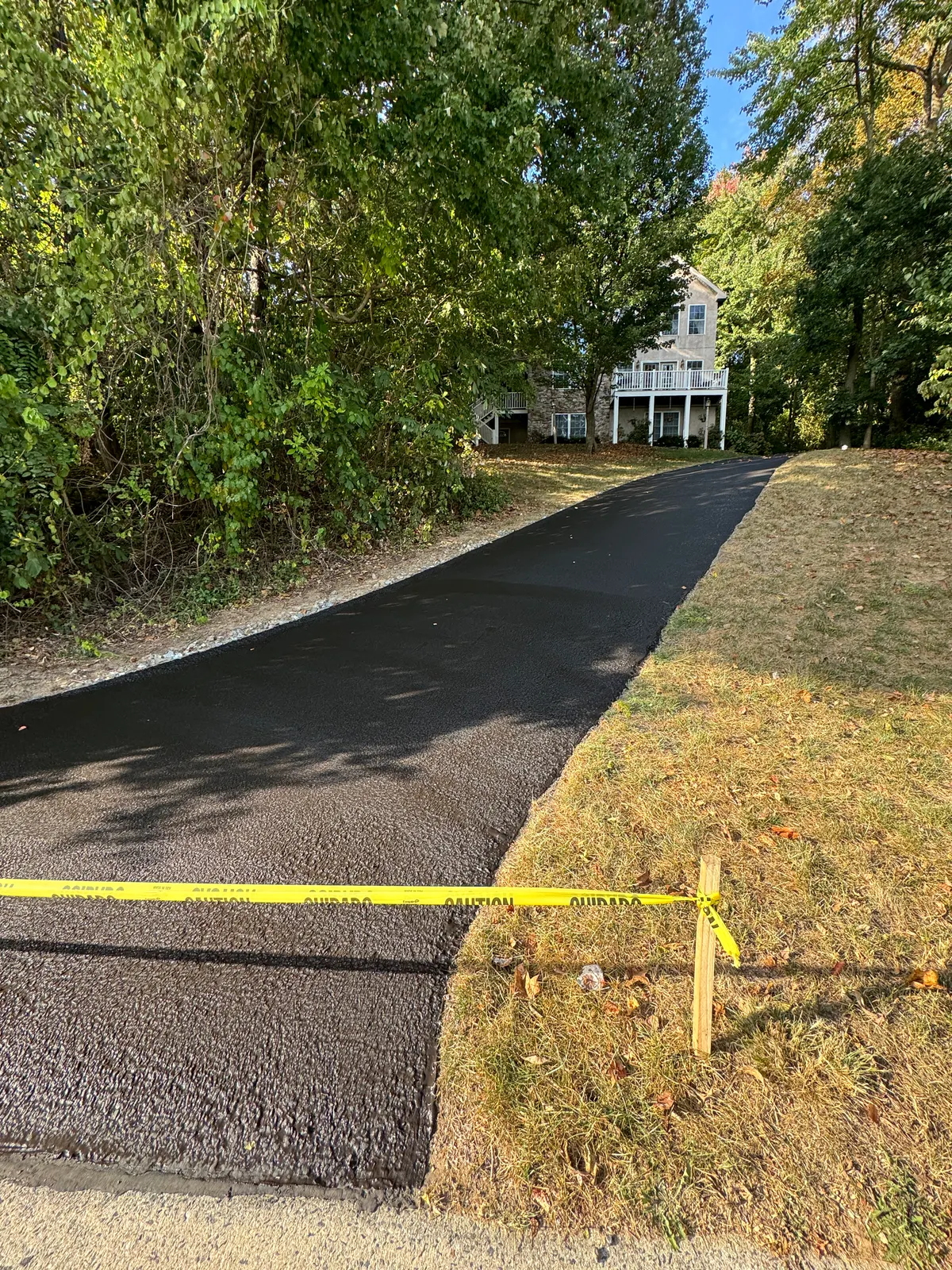
- A sealed perimeter. Look for a band of black sealant around the seam. No sealed seam means water already has its route in.
- A tight, dense surface. Properly compacted hot mix looks uniform and closed. If you can see loose, open stones you could pluck out by hand, that patch is porous, a sponge with delusions of pavement.
One more porch-level test: age. Ask any contractor how long their patches last and whether they’ll show you one from three years ago. We can, and will, it’s the fastest way to separate process from promises.
Watch the Process Done Right
If you’d rather see it than read it, this walkthrough of proven patching practices shows the cut-clean-fill-compact sequence on real pavement. Count how many minutes pass before new asphalt actually enters the hole:
That’s the standard we hold on every job, whether it’s a farm lane outside Strasburg or a business entrance in Denver, PA. Full details on what’s included are on our pothole repair service page.
Frequently Asked Questions
How long does a pothole repair take?
Most residential repairs are done in a few hours, including cutting, base work, and compaction. You can usually drive on a hot mix patch the same day once it’s cooled, we’ll give you a specific window before we leave.
Why do you cut the hole bigger before filling it?
Because the asphalt around a pothole is damaged beyond what you can see. Cutting back to sound material with clean vertical edges gives the patch solid walls to bond to and compact against. A patch bonded to crumbling edges inherits their failure, usually within a year.
What’s the difference between cold patch and hot mix?
Cold patch is a bagged, workable-in-any-weather material designed for temporary fills, it never fully cures and typically lasts a season. Hot mix is fresh 300°F asphalt, placed in layers and compacted to full density. It’s a permanent repair, but it’s only available when asphalt plants are running, roughly April through November here.
Will the patch match my existing driveway?
A fresh patch is darker than weathered asphalt at first, new asphalt always is. It blends as it oxidizes over a season or two, and if we sealcoat the driveway afterward, the whole surface comes out one uniform black immediately.
Can you just fill the cracks around the pothole too?
Please let us. Cracks are how the next pothole is already forming, and filling them while the crew is on site costs far less than a separate visit later. Most of our repair jobs end up as patch-plus-crack-fill for exactly this reason.
Ready for a Repair That Stays Repaired?
If you’ve got a pothole that keeps coming back, or one you’d like to fix right the first time, get in touch for a free quote or call us at 717-808-1600. We’ll cut it clean, build it from the base up, and you can go back to ignoring your driveway, which is what a good driveway is for.