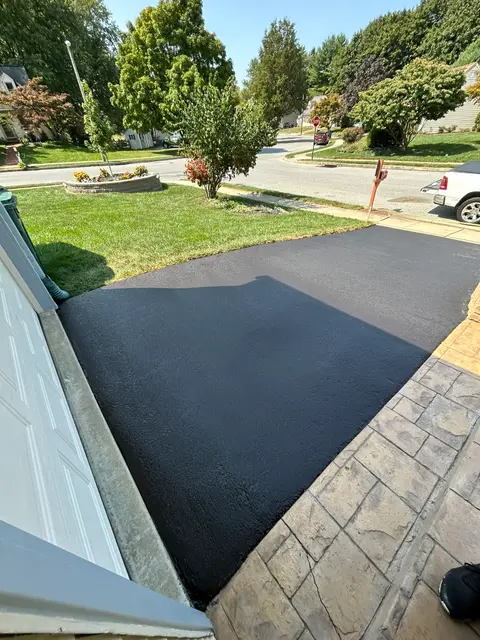

Strasburg is home base for us, so this one was a short drive. The house is a Cape Cod style home on a quiet street with a driveway that slopes from the road up toward the garage. What made the job interesting is what runs beside it: a stamped concrete walkway with a decorative pattern, separated from the asphalt by nothing but a straight line. Sealer on that walkway would have been a permanent stain. Keeping it clean was the whole job.
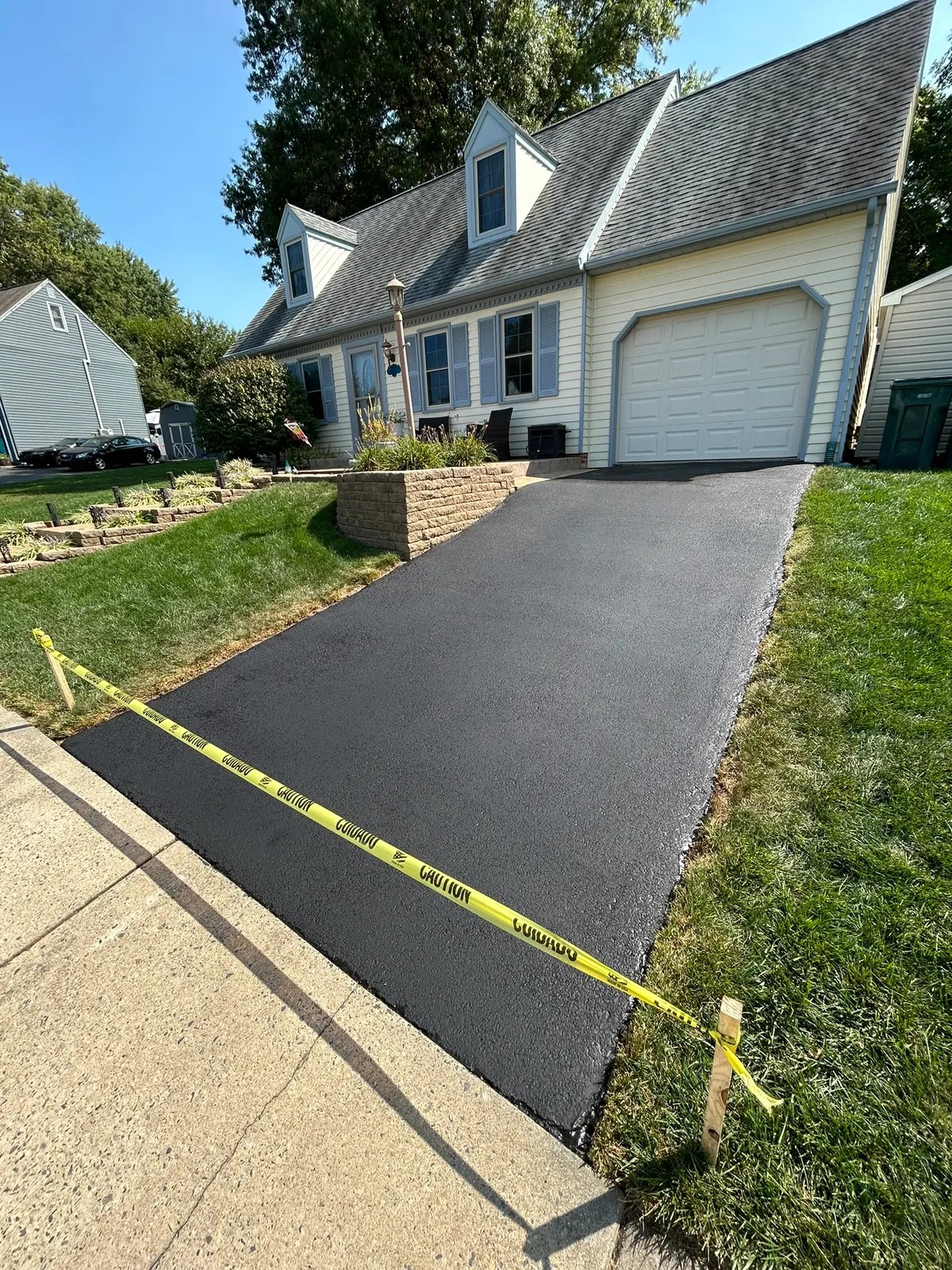
The driveway before
The asphalt itself was in good shape. It had faded to the grey color that asphalt turns after a few years in the sun, with some fine surface wear but no real cracking and no soft spots. That is the ideal time to seal. Sealcoating protects pavement that is still sound; it does not rescue pavement that has already failed. A driveway at this stage gets the most benefit from a coat of sealer, because the sealer is doing its job of blocking sun and water before any damage has started.
The homeowner wanted two things: protection before winter and the deep black look that a fresh sealcoat gives a driveway. September is a good month for both. The days are still warm enough for the sealer to cure properly, the nights are cooler, and the leaves have not started to fall onto wet sealer.
Working next to stamped concrete
Decorative concrete is expensive, and sealer is permanent on it. We treated the edge along the walkway as the most important part of the job.
- Clean break first. Before anything was applied, the joint between the asphalt and the concrete was blown clean so the sealer would stop at a crisp line rather than wicking into dirt along the edge.
- Edges by brush, not by spray. The spray wand never came near the walkway. The strip of asphalt along the concrete was cut in by hand with a brush, which gives a straight edge and keeps the sealer exactly where it belongs.
- Protection where needed. The lower edge of the walkway, where sealer could run downhill toward it, was masked.
- Check the line between coats. After the first coat we walked the full length of the edge and corrected anything before the second coat went on.
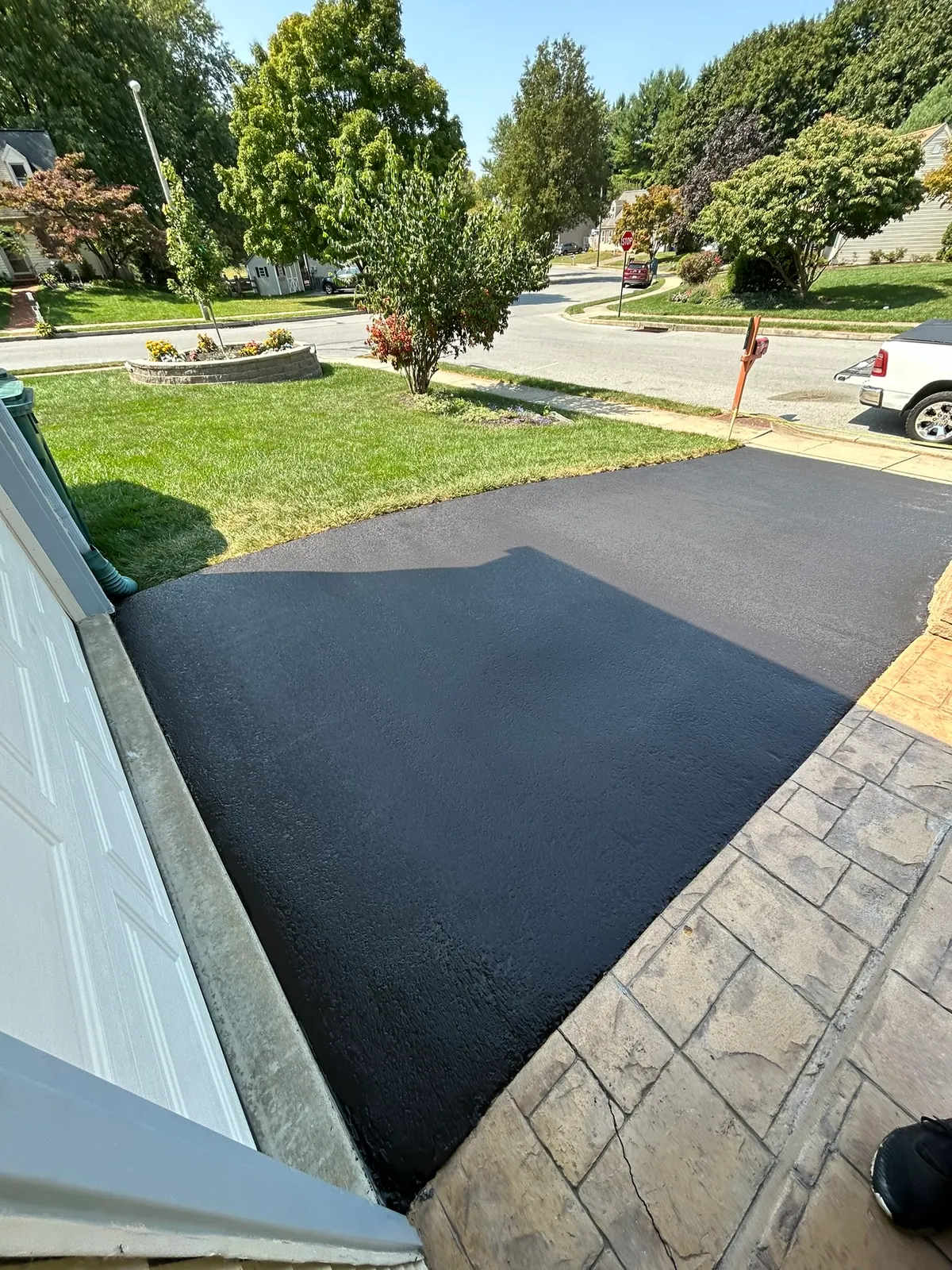
The result is a sharp, straight line between black asphalt and patterned concrete, with no sealer on the walkway and no bare asphalt along the edge.
Dealing with the slope
A sloped driveway changes how sealer behaves. Applied too heavily, it runs downhill and pools at the bottom, leaving a thick, slow curing band near the road and a thin coat near the garage. We applied from the top down in thin, even coats, kept the wand moving, and watched the low edge so that nothing collected there. Two thin coats always beat one thick one, and on a slope that is doubly true.
Prep and application
The sequence was the same one we use on every driveway:
- Clear and clean. The surface was blown free of dirt and debris, and the grass line along the lawn edge was trimmed back so the sealer could reach the actual edge of the asphalt.
- Oil spots. Any oil spots were treated with primer so the sealer would bond to them instead of peeling.
- Edges by hand. The lawn edge, the garage apron and the full length of the walkway were brushed in by hand.
- First coat. Sprayed in even passes from the top of the drive down.
- Second coat. Applied after the first had set, in the opposite direction, to even out the coverage.
- Cure. Cones and tape went up, and the homeowner had a clear time for when the driveway could be walked on and when it could be driven on.
What the homeowner should expect
A sealed driveway at this stage of life should go three to four years before it needs another coat. Sun and tire traffic wear it gradually, and the wheel paths will start to look a little lighter before the rest. When the black starts turning grey again, that is the time to call.
In the meantime, a few habits keep it looking good:
- Stay off it for the full cure time we give you, usually 24 to 48 hours depending on weather.
- Avoid turning the steering wheel while the car is standing still for the first couple of weeks. Fresh sealer can scuff under a pivoting tire.
- Keep leaves and debris from sitting on the surface through the fall, since they hold moisture.
- Clean up oil drips when they happen. Fresh spots wipe off; old ones soak in.
Why we like September for driveways
Homeowners often call in spring, but late summer and early fall are our favorite time for residential sealcoating in Lancaster County. The weather is stable, humidity is lower than in July, the sealer cures evenly, and the driveway goes into winter protected. A September coat means the first freeze and thaw cycles of the year hit a sealed surface, not a porous one.
The one thing to watch in fall is leaves. Once trees start dropping, leaves on wet sealer leave marks. We schedule around that, and on this street, in mid September, it was not yet an issue.
Is your driveway ready to seal?
This driveway was at the right stage. Yours may or may not be. A quick check:
- Color. Grey or faded asphalt with the stones starting to show is ready. Deep black asphalt that was sealed in the last two years can wait.
- Age. New asphalt needs six to twelve months to cure before its first seal. Sealing too soon traps oils and the coating can fail.
- Cracks. Hairlines are fine to seal over. Cracks you can fit a credit card edge into should be filled with hot rubber first, and we do that as part of the job when it is needed.
- Surface. Solid is good. Crumbling edges, soft spots or a web of alligator cracks mean repair comes before sealing, or instead of it.
- Drainage. Puddles that sit for hours after rain wear sealer faster and point to a low spot in the base.
If you are not sure, send a few photos. We will tell you whether sealing makes sense this year or whether to wait.
Sealing around concrete, pavers and garage doors
Nearly every driveway meets something that should not be sealed: a concrete apron at the garage, a sidewalk at the street, a paver walkway, stone edging, a garage door. The sealer has to stop exactly at the joint. On this driveway it was the stamped concrete walkway. On others it is a brand new garage door or a brick border.
How we handle those edges:
- The joint is blown clean so sealer stops at a crisp line.
- The strip of asphalt along the edge is cut in by brush, never sprayed.
- Vertical surfaces that sealer could splash onto, like a garage door or siding, are protected.
- We walk the edges with you before we start so you can point out anything you are worried about.
If your driveway has decorative concrete, pavers or fresh paint next to it, mention it when you book. It changes how we plan the edges, not the price.
How a driveway like this is priced
Driveway sealcoating is priced by size and condition. A long driveway with turnarounds takes more material and time than a short two car drive, and cracks that need hot rubber filling add to the job. We look at the driveway, in person or from a few photos, and give you a free written price before anything starts. Sealcoating costs a small fraction of what repaving does, which is the whole reason to do it on schedule.
Questions homeowners ask about sealcoating
Why not seal every year?
Sealer builds up. Coats applied too often form a thick layer that cracks and flakes instead of wearing gradually. Every three to four years is the right rhythm for most driveways.
Spray or squeegee?
We spray for even coverage and use a squeegee and brush where the surface or the edges call for it. The method matters less than two thin coats, clean prep and hand cut edges.
Does a sloped driveway need anything special?
Thinner coats applied from the top down, and attention to the low edge so sealer does not pool. It is a normal job with a little more care.
How long until we can drive on it?
Usually 24 to 48 hours. Cool, shaded or humid conditions push toward 48. We give you a specific time before we leave.
Will the new coat hide cracks?
No. Sealer is a thin protective layer. Cracks need to be filled first, and filled cracks remain faintly visible under the sealer as smooth black lines.
Details
- Residential driveway sealcoating in Strasburg, PA, Lancaster County, September 2024.
- Sloped asphalt driveway at a Cape Cod style home, bordered by a stamped concrete walkway.
- Two coats applied top down, all edges including the full walkway cut in by hand, concrete kept clean.
- Surface cleaned, oil spots primed, cure time and care instructions given to the homeowner.
Lancaster Lines & Asphalt seals driveways across Lancaster County, including right here in Strasburg. You get a free written price before we start. See the driveway sealcoating page and our Strasburg service page, or request a free quote.