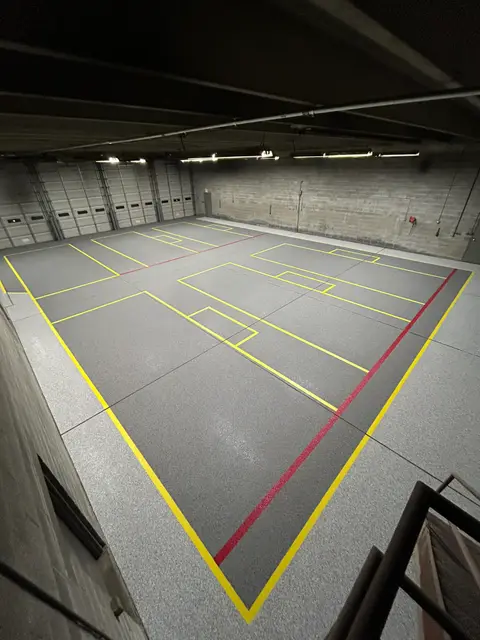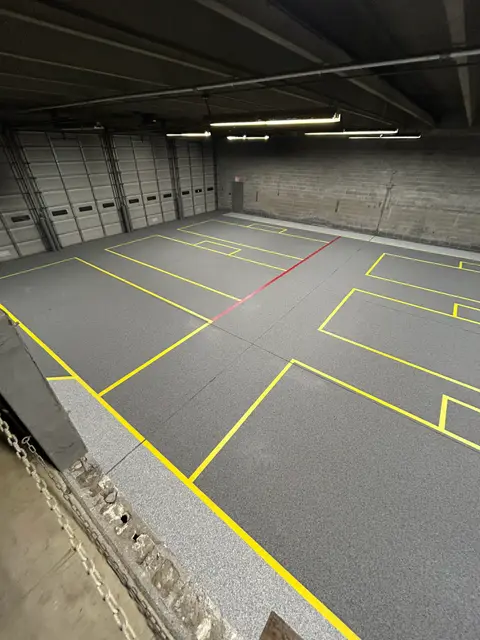

Most of what we do happens outdoors between April and November. This job was the opposite: the end of January, indoors, on a sealed concrete floor in a warehouse in Chambersburg, about an hour and a half west of our base in Lancaster County. Floor marking is one of the few striping jobs that does not care what the weather is doing, which makes it a good fit for the winter months when parking lots are frozen and nobody is sealcoating anything.
What the facility needed
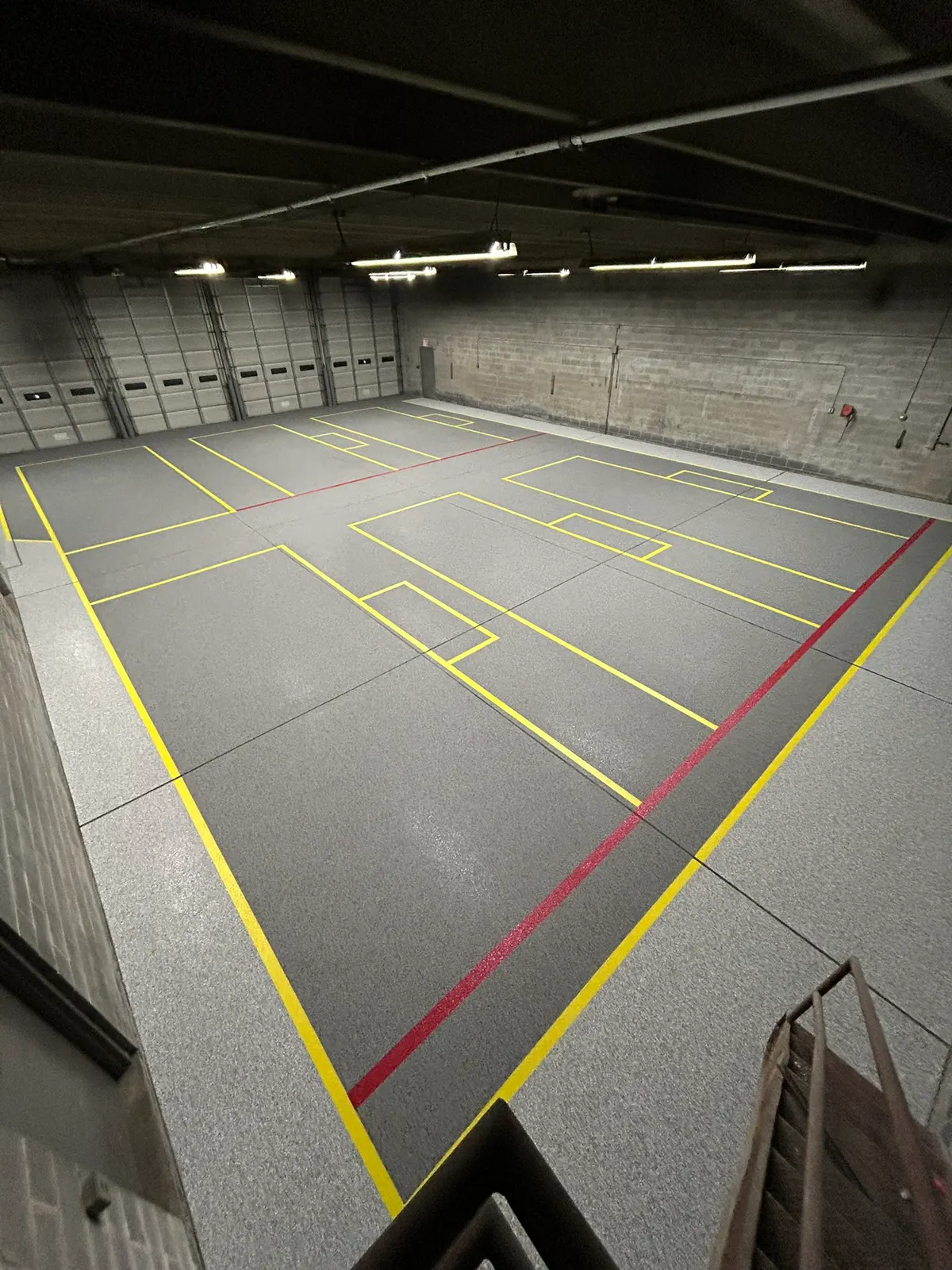
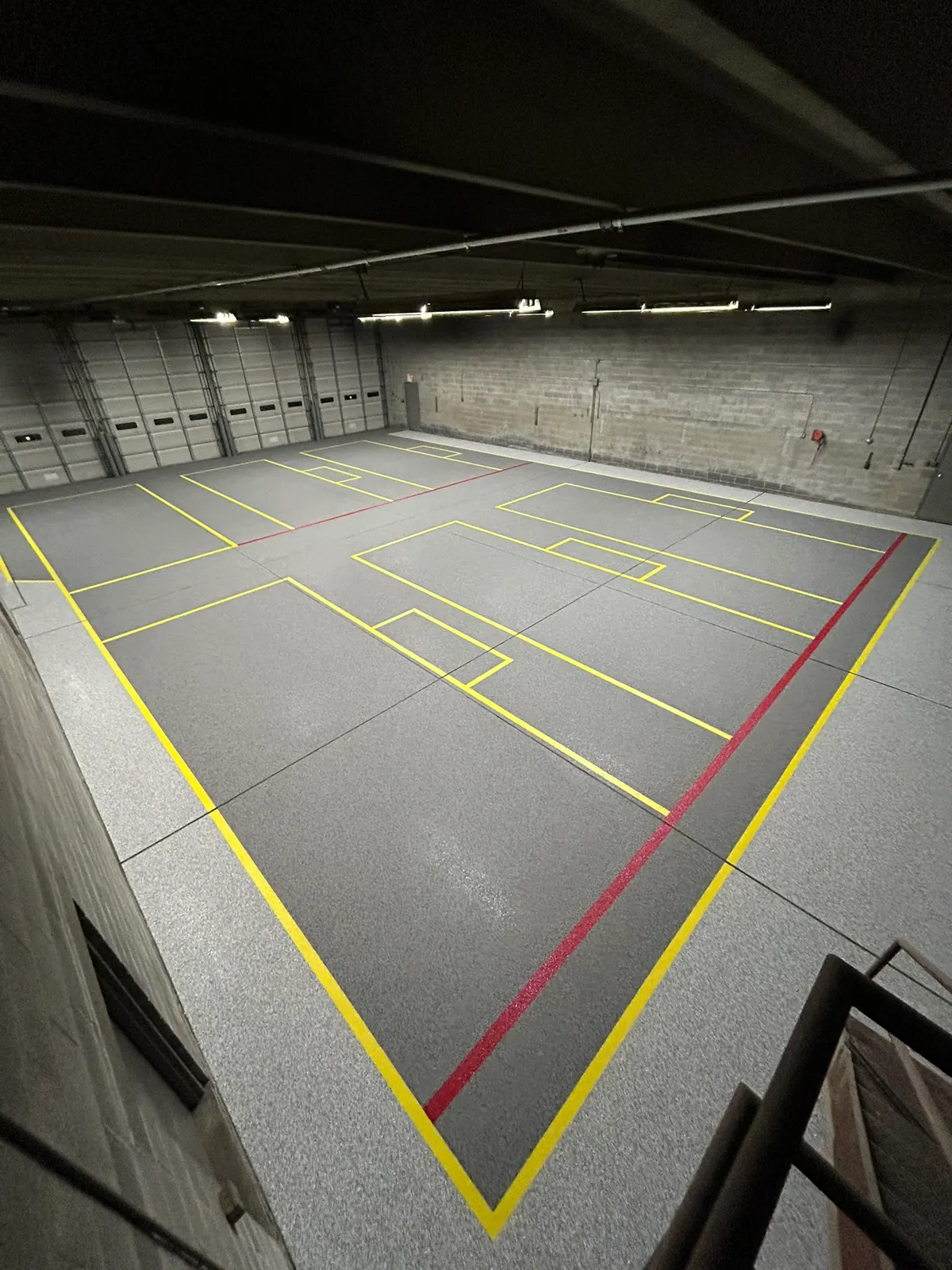
The building is a working warehouse with a row of dock doors along one wall and a wide open floor in front of them. The floor itself was in good shape, a light grey sealed concrete with a slight texture, but it had no markings at all. Without lines, a floor like this gets used however the day goes. Pallets end up wherever a forklift sets them down, the path in front of the dock doors gets narrower every week, and nobody can say for sure where a person is supposed to walk.
The facility wanted three things on the floor:
- Lane lines that define where equipment travels and keep a clear path along the dock doors.
- Bay boundaries, rectangular zones where pallets and material can be staged without creeping into the lanes.
- A red boundary line across part of the floor, marking an area the facility wanted treated differently from the rest. Red is the standard color for restricted or hazard zones, so we used it exactly where their plan called for it and nowhere else.
Yellow was used for everything else. Yellow is the conventional color for aisles, traffic lanes and caution areas on industrial floors, and it reads clearly against grey concrete under warehouse lighting.
Laying out an indoor floor
Floor marking looks like parking lot striping, but the layout work is different. There are no curbs or existing lines to work from, the dimensions come from the building's own plan, and everything has to line up with fixed features: the dock doors, the columns, the walls. If a lane line drifts even a few inches over a long run, you can see it from across the building.
We started by walking the floor with the people who run it. We talked through how forklifts move between the dock doors and the storage area, where material gets staged while it waits, and which parts of the floor need to stay open. Then we measured from the walls and door openings and snapped chalk lines for every line and box. The chalk layout is the point where things get adjusted. It is far cheaper to move a chalk line than a painted one.
A few things we paid attention to on this floor:
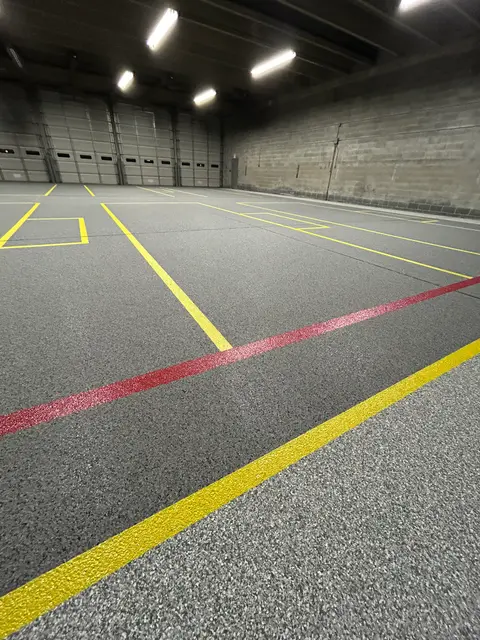
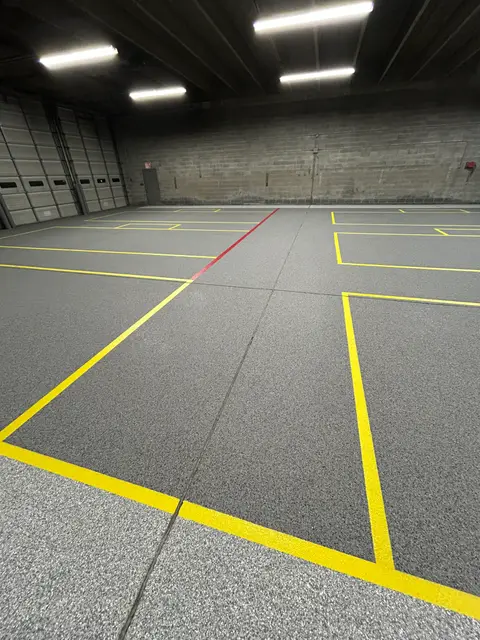
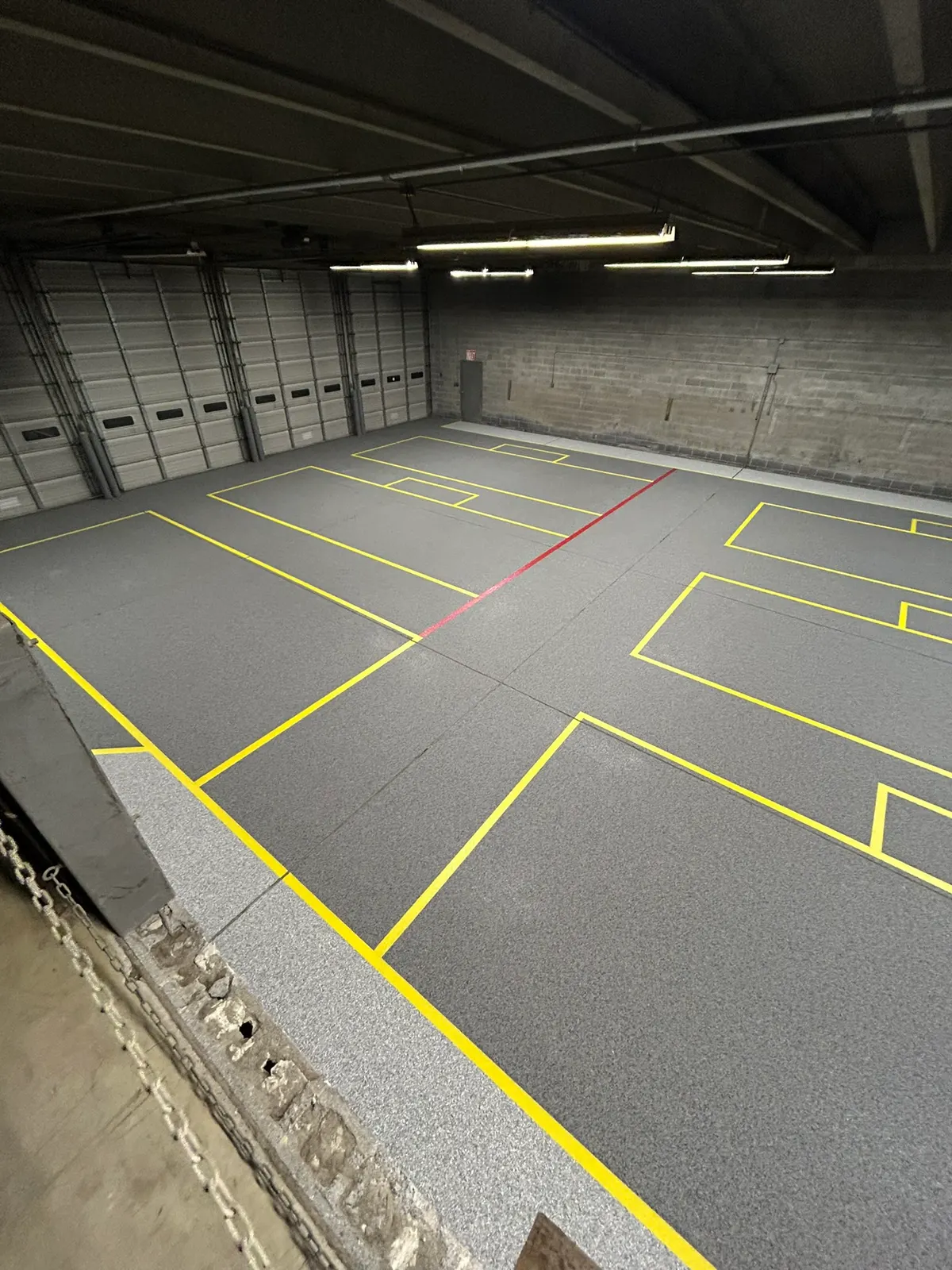
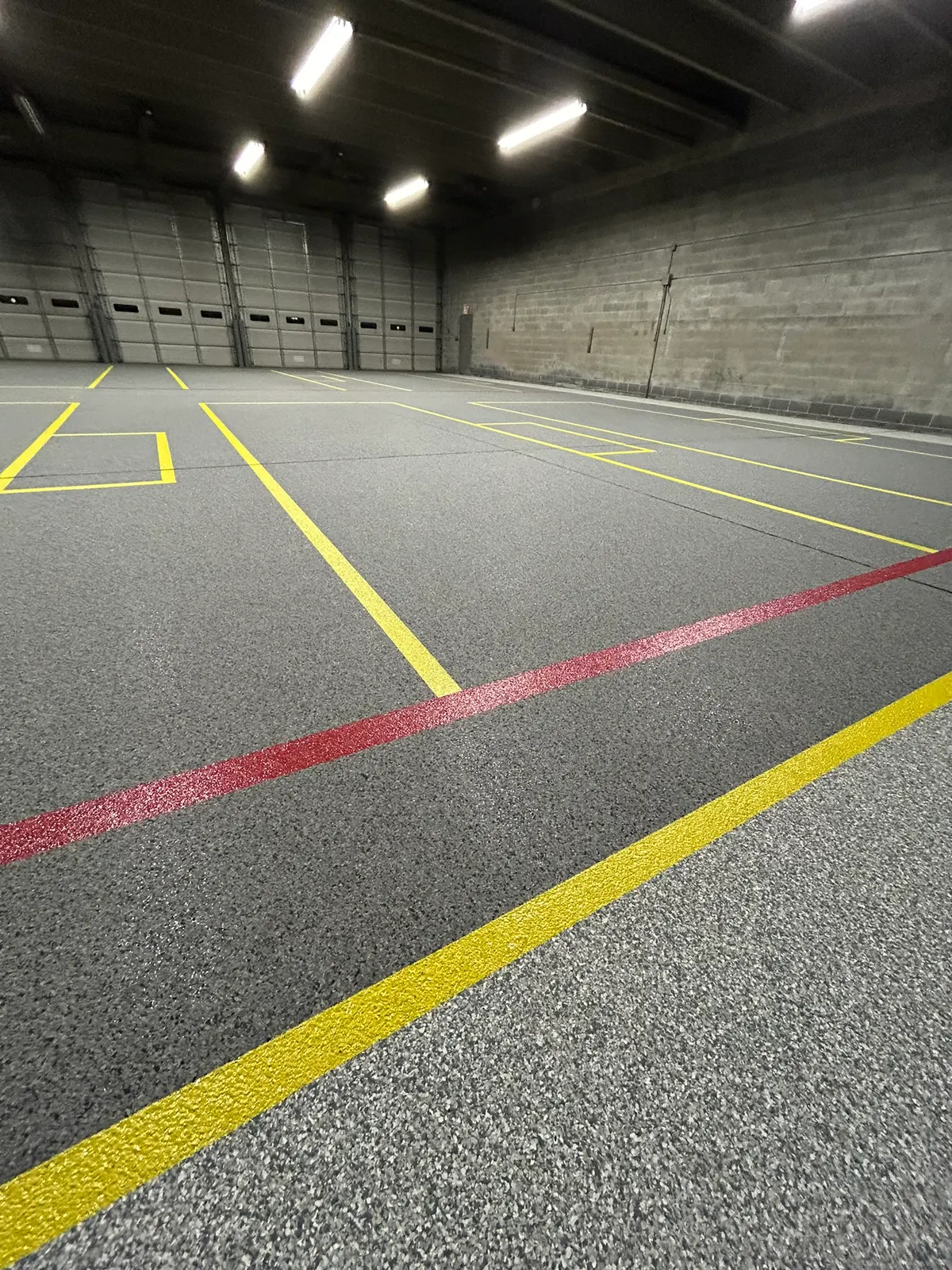
- Consistent line width. All the yellow lines were painted at the same width so the floor reads as one system, not a patchwork.
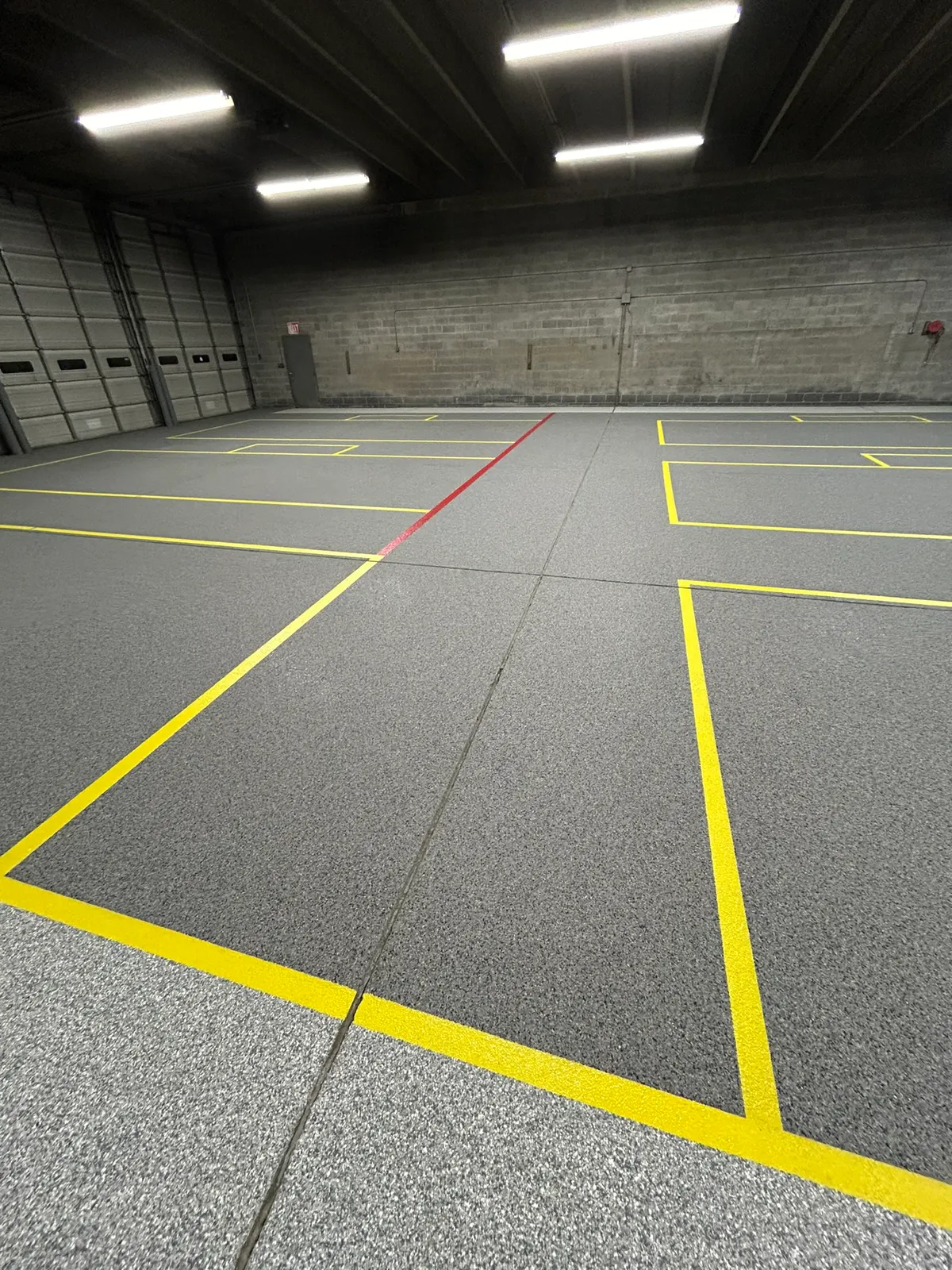
- Square corners. The bay boxes are rectangles with crisp corners. Rounded or ragged corners are the first sign of rushed floor work.
- Clearance in front of the dock doors. The lines leave a clear working zone in front of each door so a truck can be unloaded without blocking the main lane.
- The red line. It runs clean and straight across the floor, with a sharp edge, so there is no question where the boundary is.
Prep on a sealed concrete floor
Paint is only as good as the surface under it. A sealed concrete floor is smoother than bare concrete, which is good for cleanliness but means the paint has less to grip. Before any paint went down we swept and cleaned the floor along every line path and made sure there was no dust, oil or residue where the paint would sit. We scuffed the surface lightly where needed so the coating could bond.
The paint itself is a floor marking product made for concrete, not the traffic paint we use on asphalt lots. It is applied with a striping machine for the long lines and by hand at corners and ends. Floor paint needs time to cure before forklifts run across it, so we planned the work so that lanes could be painted and cured in sections rather than closing the whole floor.
Working while the building stays open
A warehouse does not stop for painters. We set up in sections, coned off the part of the floor we were working on, and kept the rest open to forklifts. The crew coordinated with the people on the floor so no equipment crossed fresh paint. By the end, the whole layout was down and the facility had not lost a shift.
This is the same approach we take on retail parking lots: do the work in pieces, keep the business running, and leave nothing half finished at the end of the day.
Why painted lines matter on a floor like this
It is tempting to treat floor marking as decoration. It is not. OSHA requires that permanent aisles and passageways in a workplace be appropriately marked, and it expects walking and working surfaces to be kept clear. Beyond the rule, the practical benefit is obvious the first week after the lines go down:
- Forklift drivers stop guessing where to drive and where to set pallets.
- Staging areas have edges, so the main lane stays open.
- New employees can read the floor without being told.
- Supervisors can see at a glance when something is parked where it should not be.
A clear floor is also a faster floor. Material moves in straight lines, people are not stepping around pallets, and the dock doors stay accessible.
How long it lasts
Floor paint wears first in the places where tires turn and pivot, usually at the ends of lanes and in front of the dock doors. On a floor with normal forklift traffic, expect the heaviest wear points to need touch ups in a year or two, with the rest of the layout lasting longer. When we finish a floor we tell the client which spots to keep an eye on. Touching up a few corners is a small job compared with repainting a whole layout, and it keeps the floor looking like it did on day one.
What we would tell another facility manager
If you are thinking about marking a warehouse or production floor, a few lessons from this job:
- Start with how the floor is actually used, not how the plan says it should be used. A short walk with the forklift operators saves a lot of repainting.
- Pick a color code and stick to it. Yellow for lanes and caution, red for restricted or hazard zones, white for storage. Mixing colors without a rule makes the floor harder to read, not easier.
- Do it in winter if you can. Floor marking is indoor work. Our calendar is open in January and February, and your lot is probably not getting sealcoated or striped then anyway.
- Plan for sections. Nobody wants to close a warehouse for a day. Lines can be painted and cured in pieces around your schedule.
- Budget for touch ups. The high traffic ends of lanes wear first. A small yearly touch up keeps the system intact.
Questions facility managers ask about jobs like this
Does the floor have to be closed?
Not the whole floor. We cone off the section we are painting, let it cure, and move on. On this job the facility ran through the day. For floors that run two or three shifts, overnight or weekend work is the usual answer.
Our floor already has a coating. Can you paint on it?
Usually yes. Sealed, polished and epoxy coated floors need light scuffing along the line paths so the paint can grip, and oily spots need degreasing. We test a short section first. The one surface that does not take paint well is a floor that is actively dusting or flaking, which needs to be fixed before any lines go down.
Why not just use floor tape?
Tape is quick and easy to change, which makes it fine for temporary layouts. Under forklift traffic the edges lift and the tape tears, usually within months. For a permanent layout on a large floor, paint lasts longer and costs less over time.
What happens when we move racking next year?
Old lines can be ground off or painted out and new lines laid. It is easier if the layout was planned with some flexibility to begin with, which is one reason we spend time on the chalk layout before painting. If you expect the layout to change often, say so and we will plan for it.
How do we know how many feet of line we have?
Sketch the layout with rough dimensions and send photos. Floor marking is quoted by the linear foot of line, plus prep and any stencils. We confirm the footage on site before the price is final.
Details
- Warehouse floor line marking on a sealed concrete floor, Chambersburg, PA, Franklin County.
- Completed at the end of January 2025, indoors, while the facility stayed in operation.
- Yellow lane lines and bay boundaries, one red boundary line, consistent line width throughout.
- Surface cleaned and scuffed before painting, work done in sections with cones.
Lancaster Lines & Asphalt does floor marking for warehouses, shops and industrial buildings across Lancaster County and, for larger jobs like this one, well beyond it. If your floor has no lines, or the old ones have worn off, send a few photos and the rough dimensions and we will give you a plan and a price. See the warehouse floor marking page for what is included, or request a free quote.