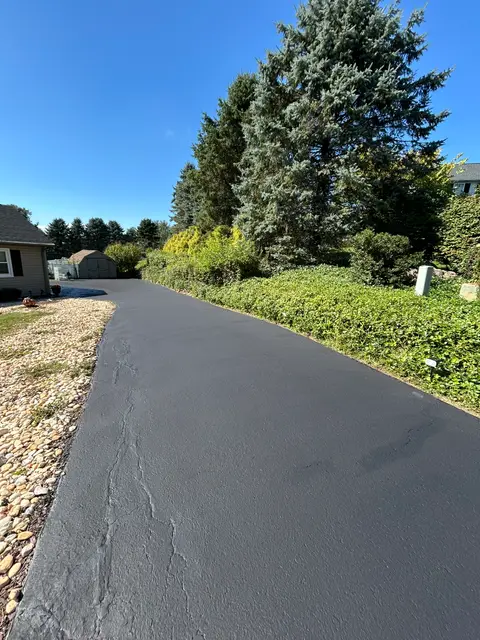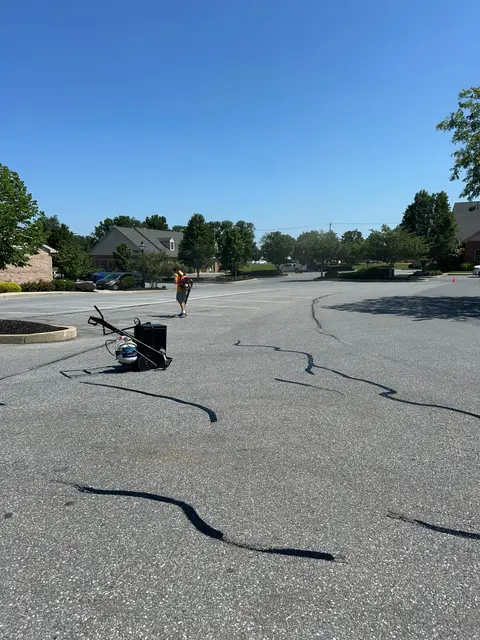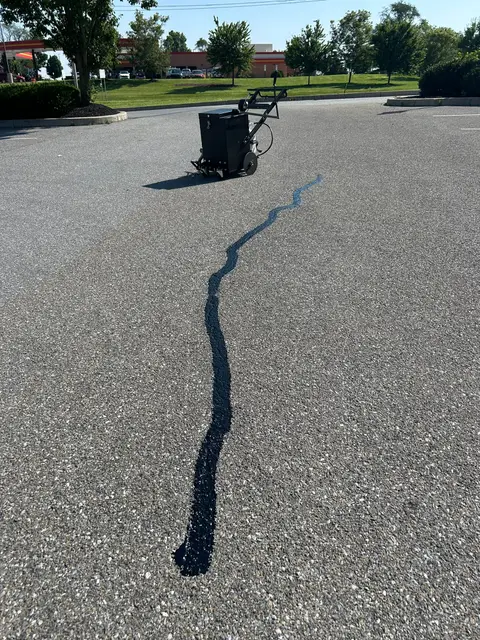
You’ve seen the failed version of this job. Somebody squirted black goo into a driveway crack two summers ago, and now that goo is sitting proudly on top of the pavement like a dried-up licorice rope, while the crack underneath has reopened and invited three friends. That’s what happens when crack sealing is treated as “pour black stuff in gap.”
Hot pour crack sealing done properly is a different animal. It’s a process with real steps, real temperatures, and one rule that decides whether the repair lasts five years or five months. This post walks you through exactly how we do it at Lancaster Lines & Asphalt, so you know what you’re paying for, and what to watch for if anyone else is holding the wand.
What “Hot Pour” Actually Means
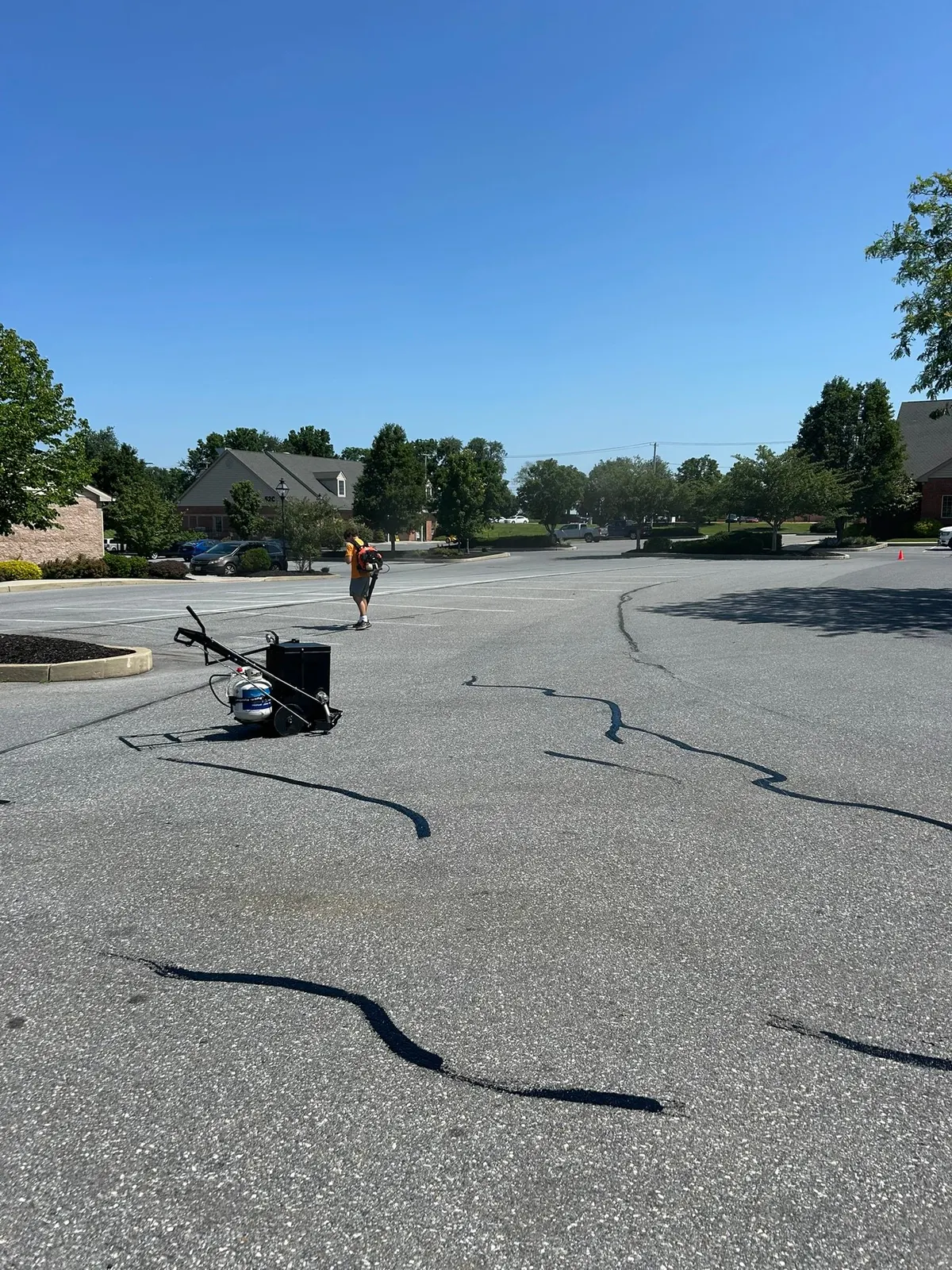
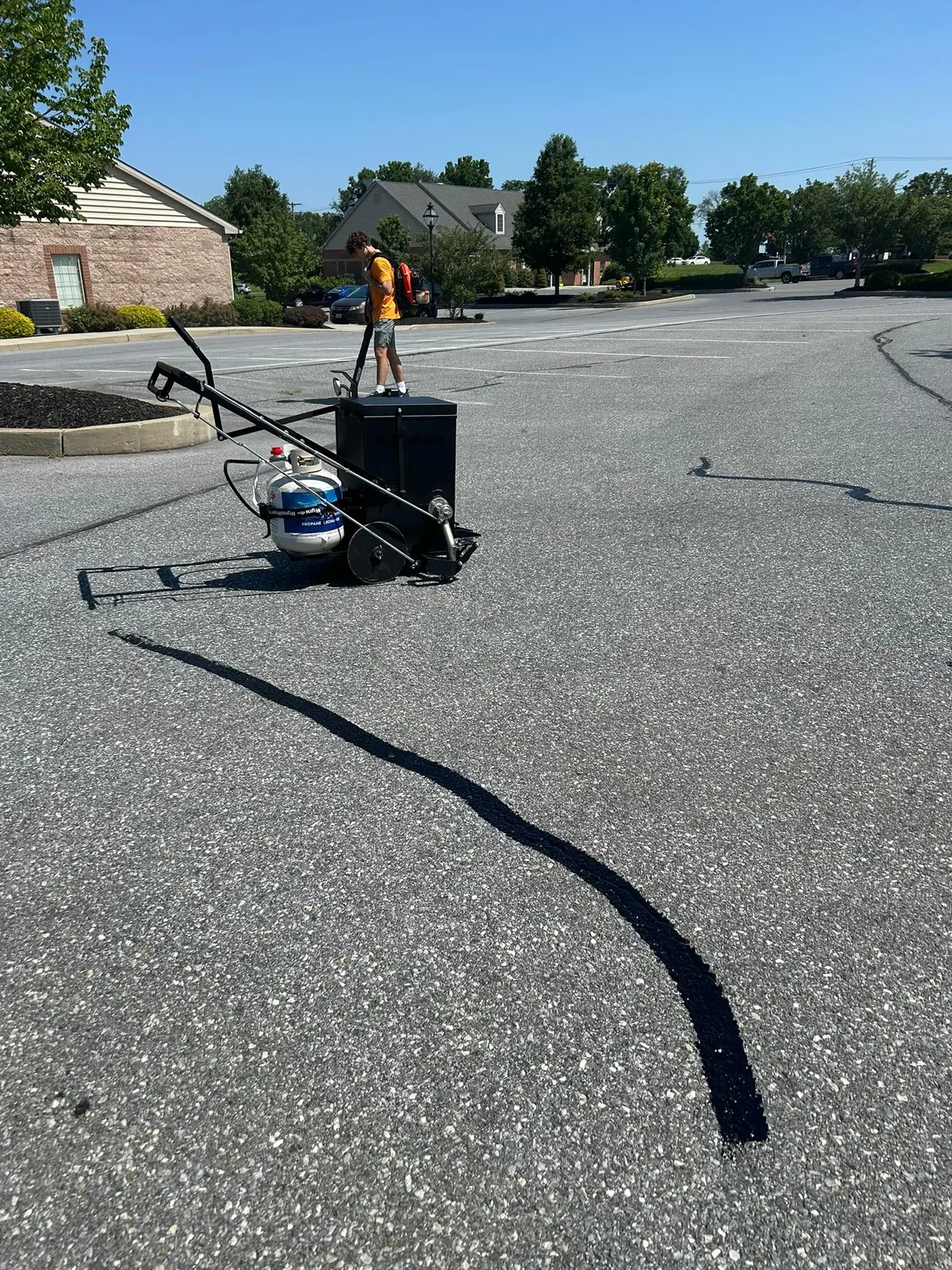
Hot pour sealant is a rubberized asphalt compound that arrives at the job as solid blocks. We load those blocks into a melter, an oil-jacketed kettle on wheels, and heat them to roughly 400°F. At that temperature the rubber flows like warm syrup, pours deep into a crack, and bonds to the crack walls as it cools.
The magic isn’t the heat itself. It’s what the heat buys you: a material that cures into flexible rubber instead of a rigid crust. Your pavement moves constantly, expanding in July, contracting in January, flexing every time a delivery truck rolls over it. A rigid filler cracks along with the pavement. Hot pour rubber stretches and rebounds, staying bonded through Lancaster County’s dozens of freeze-thaw cycles every winter. The Federal Highway Administration has documented crack sealing as one of the most cost-effective pavement preservation treatments there is, when it’s done to spec.
“When it’s done to spec” is doing a lot of work in that sentence. So here’s the spec.
Step 1: Clean the Crack Like It Owes You Money
This is the step that separates a five-year repair from a one-winter embarrassment, and it’s the step cheap operators skip because you can’t see it in the finished product.
Every crack gets blown out with compressed air, dirt, dust, gravel, moisture, dead leaves, the weeds that moved in over the summer. If vegetation has rooted, it gets cut and routed out first. The goal is bare, dry asphalt on both walls of the crack.
Why so fussy? Because sealant bonds to whatever it touches. Pour 400°F rubber into a dirty crack and it bonds beautifully, to the dirt. Then the dirt lets go of the asphalt (dirt is famously non-committal), and the whole plug pops out the first time the pavement flexes. A dirty crack equals a failed seal, full stop. When you see crack filler lying loose on a driveway like shed snake skin, you’re looking at a prep failure, not a material failure.
Step 2: Heat the Rubber to 400°F
While the cracks are being cleaned, the melter is doing its job. Temperature control matters more than you’d think. Too cool, and the sealant is thick sludge that sits on the surface instead of penetrating, you get a speed bump, not a seal. Too hot, and you scorch the polymers that make the rubber flexible, which quietly ruins the one property you’re paying for.
Proper melters are oil-jacketed with thermostatic control, holding the sealant in the manufacturer’s recommended window all day. That’s one reason this isn’t a driveway-DIY setup: the machine that does this correctly costs more than most used cars.
Step 3: Fill From the Bottom Up
The applicator wand goes into the crack, and the sealant fills from the bottom toward the surface. This matters because a crack is a canyon, not a scratch, many are an inch or more deep. Fill only the top half inch and you’ve built a rubber bridge over a hollow: traffic flexes it, winter stresses it, and it caves.
Filled properly, the sealant contacts the full depth of both crack walls. When water hits it, and in Pennsylvania, water always hits it, there’s no path down to the stone base. That’s the entire mission. Water that reaches the base freezes, expands roughly 9% in volume, and starts jacking your pavement apart from below. Keep the water out and you’ve broken the failure cycle before it starts. That’s the difference between this and pothole repair: one prevents the crater, the other is the crater.
Step 4: Strike Off, Cure, Reopen
After filling, the sealant gets struck off, leveled into a neat band over the crack, sometimes with a slight overband that seals the crack edges too. Then it cools. Hot pour cures fast: most jobs can take foot traffic within the hour and vehicles shortly after. No 48-hour driveway exile, no cones in your yard all weekend.
Want to see the whole sequence in motion? This video shows hot rubber crack sealing up close:
Why It Survives a Pennsylvania Winter
Lancaster County winters aren’t just cold, they’re indecisive. Freeze Monday night, thaw Wednesday afternoon, repeat. Each cycle, any water inside your pavement freezes and expands about 9%, prying the crack wider. Over one winter, that’s dozens of tiny crowbar sessions.
Hot pour sealant is engineered for exactly this abuse. As the crack widens in the cold, the rubber stretches. As it closes in a thaw, the rubber compresses. Materials meeting the standard specifications for joint and crack sealants (the ASTM D6690 family, the Asphalt Institute has good plain-English resources on pavement preservation materials) are tested for exactly these properties: bond, flexibility at low temperature, and resilience. The bargain-bin bottle at the hardware store is tested primarily for its ability to leave the shelf.
What Hot Pour Can’t Fix (Honesty Corner)
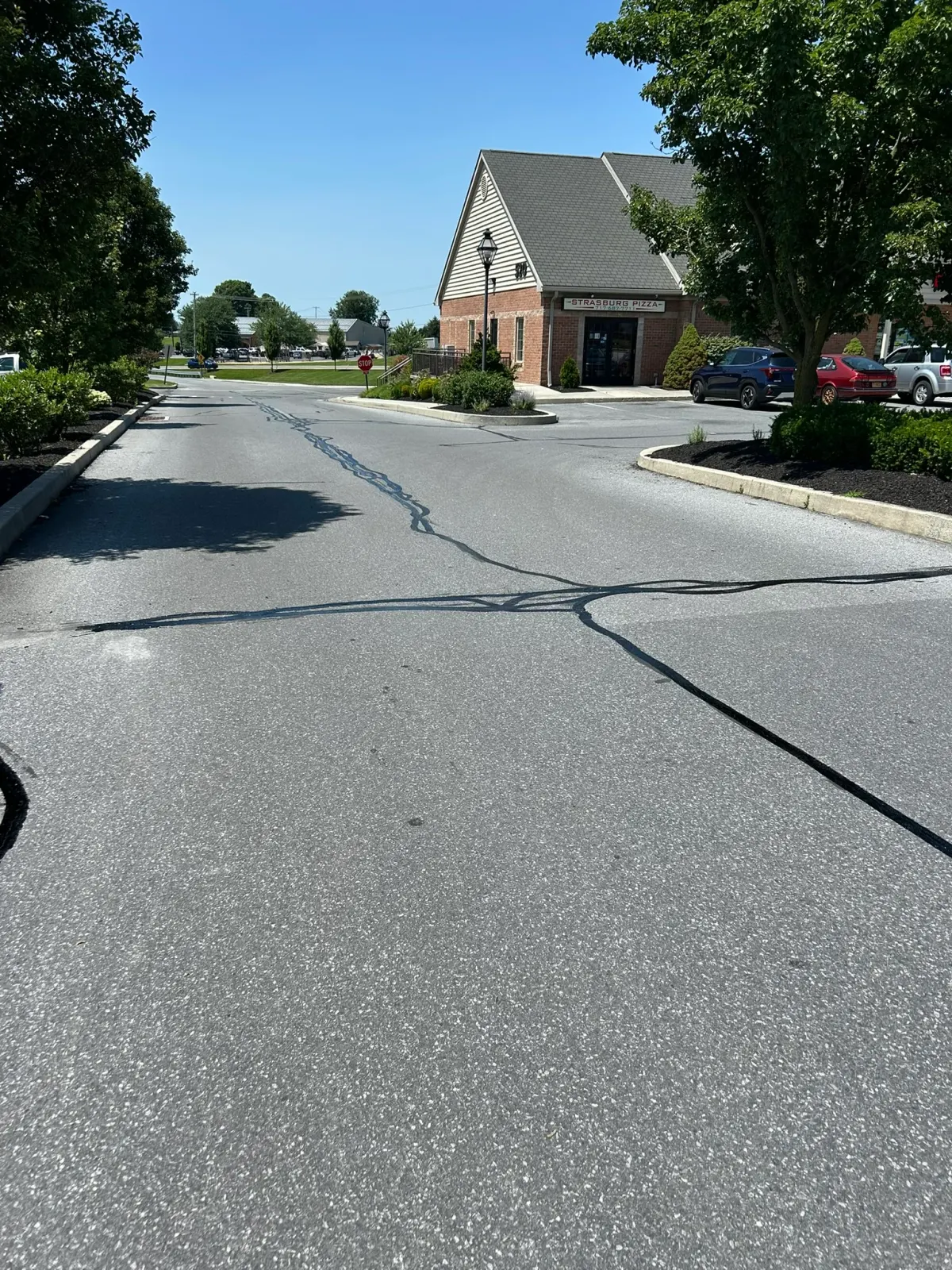
Hot pour crack sealing is for linear cracks, roughly a quarter inch to an inch wide, running as single lines across the pavement. It is not a cure for everything black and broken. Two situations where we’ll tell you no:
- Alligator cracking. That interconnected spiderweb pattern means the base under the asphalt has failed. Sealing the surface of a failed base is cosmetic at best. That area needs to be cut out and patched, or overlaid if it’s widespread.
- Very wide or sunken cracks. Past about an inch wide, or where the pavement has settled, a crack needs backer rod or patch material before sealing, or it needs actual patching. Filling a gully with sealant just builds an expensive rubber gully.
An honest contractor tells you which category your cracks fall into before quoting. If you’re wondering what the right repair costs, we broke down the numbers in our guide to crack filling cost in Lancaster County.
The Perfect One-Two: Crack Sealing + Sealcoating
Crack sealing and sealcoating are teammates, not rivals. Crack sealing closes the deep entry points; sealcoating shields the whole surface from UV oxidation and water intrusion. Doing them together, cracks first, sealcoat over top, protects the pavement at both scales, and bundling them into one visit costs less than two separate mobilizations.
We run this combo constantly for homeowners and businesses from Mount Joy to Strasburg. The result is pavement that goes into winter sealed tight and comes out in April with nothing on the punch list, a nice change from the usual spring damage report. (If last winter already did its damage, start with our spring asphalt checklist.)
Five Questions to Ask Before Anyone Heats Up a Kettle on Your Property
Not every truck with a kettle on the back runs the process you just read. A few questions will sort the pros from the pourers in about two minutes:
- “How do you prep the cracks?” The answer must include compressed air at minimum, and removing vegetation where it’s rooted. If prep isn’t mentioned in the quote, it isn’t happening on the job.
- “What material do you use, and at what temperature?” You want rubberized hot pour sealant applied around 400°F from a jacketed melter, not cold pour out of a bucket at twice the speed and half the lifespan.
- “Will you seal alligatored areas?” Trick question. The right answer is no, those areas get flagged for patching instead. Anyone who says yes is selling you a repair designed to fail.
- “How is the price calculated?” Per linear foot or a flat job price built from footage. Vague “whole driveway” pricing with no measurement usually hides either padding or corner-cutting.
- “What happens if it fails early?” A contractor who preps properly isn’t afraid of this question, because properly sealed cracks don’t pop out after one winter.
Two minutes of questions can save you from paying twice for the same footage. And if the person on the phone gets cagey about temperature or prep, that tells you everything the finished job would have told you next April.
Hot Pour Crack Sealing FAQ
How much does hot pour crack sealing cost?
Typically $1–$3 per linear foot in our area, with a $400 minimum service call, that melter doesn’t fire up for free. Most residential jobs land between $400 and $800. Exact quotes are free after we measure your actual crack footage.
How long does hot pour crack sealing last?
With proper prep and application, 3 to 5 years is typical, and often longer on lower-traffic pavement. The sealant flexes with the pavement instead of fighting it, which is why it outlasts rigid fillers several times over.
Can you do hot pour crack sealing in winter?
Cold weather itself isn’t the dealbreaker, hot pour tolerates cooler application temperatures than sealcoating. Moisture is the dealbreaker. Cracks must be bone dry, and a Lancaster County winter offers few dry windows. Fall is ideal: dry pavement, moderate crack width, and protection in place before the freeze-thaw season begins.
Is hot pour really better than the crack filler bottle from the store?
For anything you want to last, yes. Store-bought cold pour filler goes on at air temperature, sits mostly on the surface, and dries rigid, then the pavement moves and the filler doesn’t. Hot pour bonds to the full depth of the crack at 400°F and stays flexible for years. The bottle is a snack; hot pour is a meal.
How soon can I drive on sealed cracks?
Usually within an hour or two. Hot pour cures as it cools, so there’s no long closure. If we sealcoat over it in the same visit, plan on the standard 24–48 hours for the sealcoat to cure instead.
Ready to Seal Them Right?
If your driveway or lot has cracks wide enough to lose a key in, this is the repair that stops them from becoming next spring’s potholes. Lancaster Lines & Asphalt provides professional crack filling throughout Lancaster County, clean prep, 400°F rubber, done in an afternoon. Get your free quote or call 717-808-1600. Your cracks have been drinking free long enough.