Stand in the driveway aisle of any hardware store in Lancaster County and you’ll find a shelf of crack filler bottles promising to fix your asphalt for $14.99. Meanwhile, contractors like us show up with a trailer, a 400°F kettle, and a quote that starts at $400. Both products are black. Both go into cracks. So what exactly are you paying for?
The difference is hot pour vs. cold pour, and in Pennsylvania weather, it’s the difference between a repair that survives five winters and one that taps out during its first February. This post lays out how each one works, what each one costs (honestly, including the math where cold pour wins), and gives you a straight verdict for our climate.
Cold Pour: The Bottle on the Shelf
Cold pour crack filler is usually an asphalt emulsion, asphalt particles suspended in water, sold in squeeze bottles, jugs, and buckets. You pour it at air temperature, it seeps into the top of the crack, the water evaporates, and what’s left dries into a firm black filler.
Credit where due: cold pour is cheap, available on a Saturday morning, and requires zero equipment beyond gloves and optimism. For a single hairline crack on a low-traffic driveway, it genuinely beats doing nothing.
The problems show up after it dries. Cold pour shrinks as the water leaves, sometimes a third of its volume, so your filled crack becomes a half-filled crack with a dimple down the middle. It stays mostly near the surface instead of penetrating deep. And most importantly, it cures rigid. When your pavement expands and contracts (which in Pennsylvania is basically its hobby), rigid filler either cracks down the middle or loses its grip on the walls. Water resumes deliveries, and you’re back where you started, usually within one or two winters.
Hot Pour: The 400°F Rubber
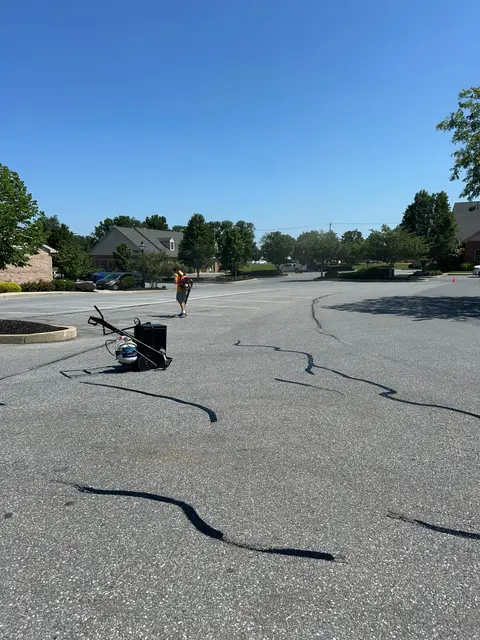
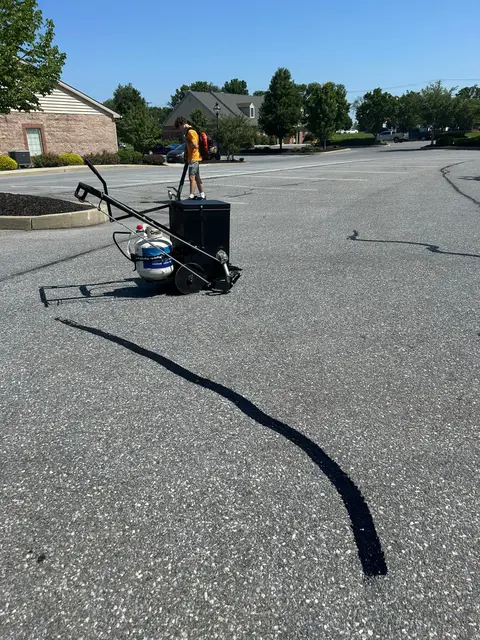
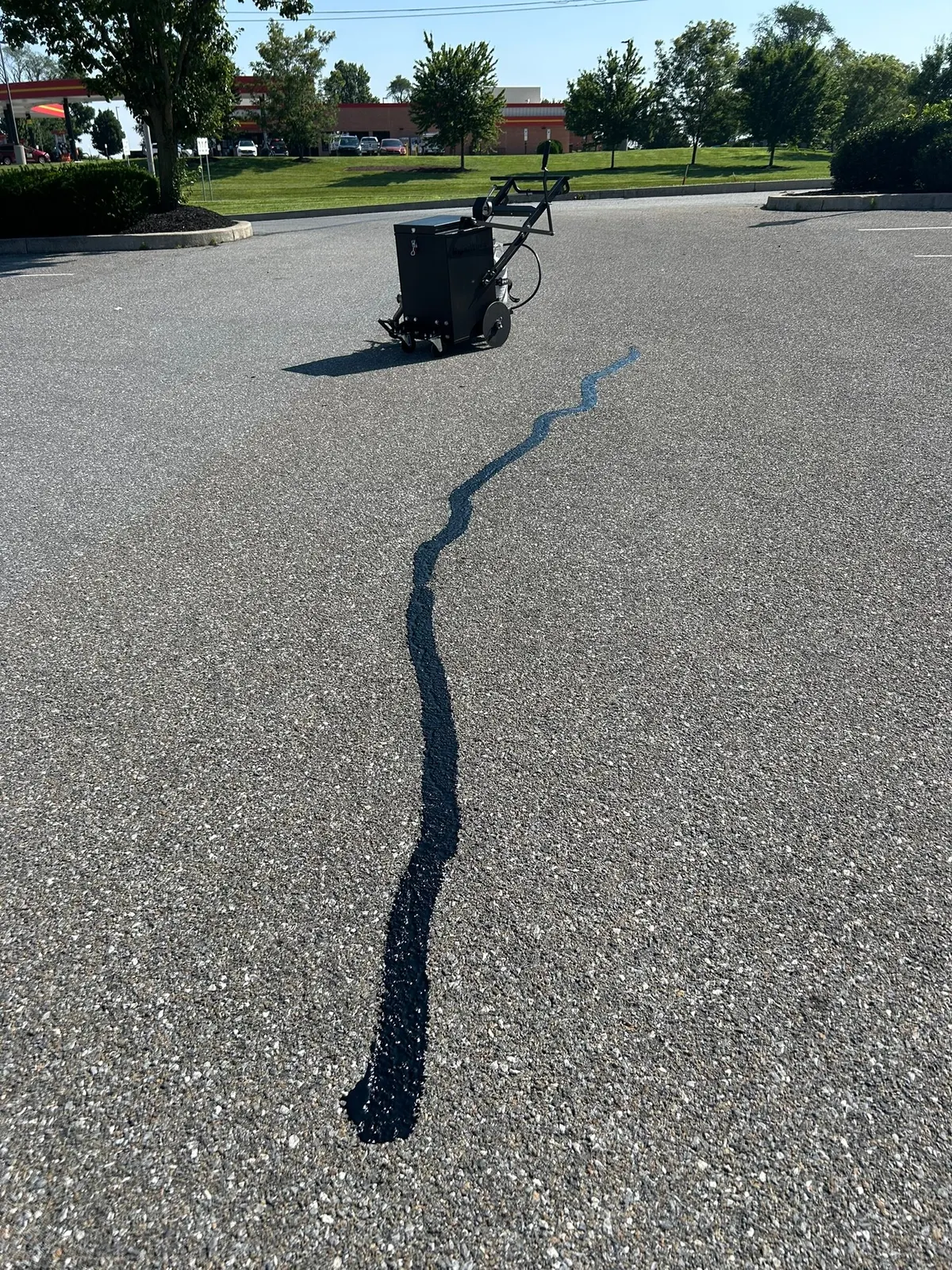
Hot pour sealant is a rubberized asphalt compound, asphalt blended with polymers and crumb rubber, that arrives as solid blocks and gets melted to roughly 400°F in an oil-jacketed kettle. At working temperature it flows deep into the crack, wets both walls, and bonds as it cools into a material that behaves like rubber, because it largely is.
That flexibility is the entire sales pitch, and it’s a good one. When a January freeze pulls the crack wider, hot pour stretches. When a July heat wave squeezes it shut, hot pour compresses. It doesn’t shrink as it cures, there’s no water to evaporate, and it fills the crack top to bottom rather than crusting over the entrance. These materials are manufactured to meet joint-and-crack-sealant standards (the ASTM D6690 family) that specifically test low-temperature flexibility and bond strength, which is exactly the abuse a mid-state winter dishes out. We covered the full application process step by step in our post on how hot pour crack sealing works.
The catch: hot pour requires a melter, an applicator, training, and enough job volume to justify all three. That’s why it’s a contractor service with a $400 minimum rather than a shelf product. Seeing them side by side makes the difference obvious:
Head to Head: The Comparison Table
The Honest Math: When Cold Pour Actually Wins
We sell hot pour, so you’d expect us to trash the bottle. But there are real cases where cold pour is the rational choice:
- One short crack, nothing else wrong. A $400 minimum for 12 feet of crack is silly, and we’ll say so. Bottle it, watch it, and call us when there’s more footage.
- You’re selling the house next spring. If the pavement just needs to look tidy for eight months, a $20 stopgap is honest economics.
- Emergency triage in November. If winter is a week away and no contractor can get to you, cold pour now is better than an open crack all winter. Just plan for the real repair in spring.
Where the math flips: any meaningful footage, any pavement you plan to keep, any crack wider than a pencil. If you re-bottle the same 150 feet of cracks every single summer, you’re spending $40 and a Saturday annually to get a worse result than one hot pour visit that lasts five years. Slow-motion overpaying, with sore knees included. Our breakdown of crack filling costs in Lancaster County runs the numbers in more detail.
Why Pennsylvania Weather Is the Tiebreaker
In San Diego, this debate barely matters, pavement that never freezes is easy to please. Lancaster County is a different exam. Our winters cycle above and below freezing dozens of times, and every cycle the water inside a crack freezes and expands roughly 9%, prying the crack open a little wider. The Federal Highway Administration identifies this freeze-thaw cycling as one of the primary drivers of pavement deterioration in northern states.
That constant movement is precisely the test rigid cold pour fails and flexible hot pour passes. A crack in Pennsylvania isn’t a fixed gap; it’s a gap doing calisthenics from December through March. The filler has to move with it or it’s out of the crack by Groundhog Day, which, fittingly, is a Pennsylvania holiday about deciding whether winter is done with you yet.
Whichever You Pick, Don’t Skip the Prep
Here’s the step that decides the outcome more than the material does: cracks must be clean and dry before anything goes in. Professionally, we blow every crack out with compressed air and remove any vegetation. Sealant bonds to whatever surface it touches, if that surface is dirt, the plug bonds to dirt, and dirt doesn’t hold hands for long. A dirty crack equals a failed seal, whether the filler cost $15 or came out of a kettle.
Also know what neither product fixes: alligator cracking. When cracks interconnect into a spiderweb pattern, the base beneath the asphalt has failed, and no pourable product rebuilds a base. That calls for cutting out and patching the area, related to what we do in pothole repair, or an overlay if it’s widespread. Any contractor pouring sealant over an alligatored section is selling you a photograph of a repair. Organizations like the Asphalt Institute make the same distinction: crack treatment is preventive maintenance for working cracks, not a structural fix.
Two Driveways, Five Years: How This Plays Out
Picture two neighbors with identical 15-year-old driveways, each carrying about 120 feet of linear cracking. Same street, same weather, same school-district taxes.
Neighbor A buys four jugs of cold pour each June. Year one looks fine through fall; by March the filler has shrunk into the cracks and split. Year two, same routine, plus a few new cracks. By year four the original cracks have widened past what a bottle can handle, two have started spiderwebbing at the edges, and one corner of the driveway is auditioning for pothole. Five-year spend: roughly $200 in product, five Saturdays on his knees, and a driveway that now needs patching measured in the thousands.
Neighbor B books one hot pour visit in September of year one, call it $450, and adds sealcoating while the crew is there. The rubber flexes through five winters without drama. Around year four or five she books a touch-up for the handful of new cracks that showed up. Five-year spend: comparable dollars, zero Saturdays, and a driveway that’s still structurally the same driveway.
The bottle never loses on sticker price. It loses on what your pavement looks like five years later, and that’s the bill that actually hurts. Asphalt failure compounds like interest: every season a crack stays open, the repair it eventually needs gets bigger. The cheapest fix is almost always the one you do earliest, with the material that holds.
The Verdict for Lancaster County
Hot pour, in almost every case that matters. The lifespan difference (3–5+ years vs. 1–2 winters), the full-depth fill, and the flexibility through freeze-thaw make it the only option that actually interrupts the crack-to-pothole pipeline. Cold pour has a niche, tiny jobs, short timelines, emergency stopgaps, and we’ll honestly point you there when it fits.
And if your asphalt is cracking, it’s almost certainly oxidizing too. Pairing crack sealing with sealcoating in one visit protects the surface and the cracks together, for less than two separate appointments. If you need convincing on the second half of that combo, here are the top 5 reasons to sealcoat your driveway.
Hot Pour vs. Cold Pour FAQ
How much more does hot pour cost than cold pour?
DIY cold pour runs $15–$50 in materials for a typical driveway. Professional hot pour runs $1–$3 per linear foot with a $400 minimum, so most homes land between $400 and $800. Per year of actual protection, hot pour is usually the cheaper product, it just collects the money up front instead of every summer.
How long does each one last?
In Pennsylvania conditions: cold pour typically fails within 1–2 winters as it shrinks, hardens, and debonds. Hot pour typically holds 3–5 years or more, because the rubber flexes with the pavement instead of fighting it.
Can either be applied in winter?
Cold pour is nearly hopeless in winter, it’s water-based and needs warm, dry days to cure. Hot pour tolerates cooler temperatures, but the crack must be completely dry, which is the hard part between December and March here. The smart window is fall, before the freeze-thaw season starts collecting rent.
Is the DIY bottle ever the right call?
Yes: one small crack, a house you’re about to sell, or emergency triage before a freeze. For real footage on pavement you’re keeping, hot pour wins the math every time. If you’re not sure which side of the line you’re on, send us a photo, we’ll tell you straight, even if the answer is “buy the bottle.”
Get the Repair That Outlasts the Winter
Lancaster Lines & Asphalt provides hot pour crack filling across Lancaster County, from Denver to Leola and everywhere between. Free quotes, honest recommendations, and rubber that’s still doing its job when the bottle stuff is long gone. Reach out online or call 717-808-1600, before your cracks start their winter workout routine.