Most Pennsylvania business owners don’t find out their parking lot is out of ADA compliance from an inspector. They find out from a demand letter. By then, the conversation isn’t about paint, it’s about attorneys, settlements, and deadlines. The frustrating part? The actual fix is usually a day of striping work. This guide covers what the Americans with Disabilities Act requires of your parking lot, in plain English: how many accessible spaces you need, exactly how big they must be, what signs go where, and what happens when a lot falls short. No legalese, no scare tactics, just the numbers, so you can check your own lot this afternoon.
Who Has to Comply (Short Answer: Almost Everyone)
The ADA applies to places of “public accommodation”, retail stores, restaurants, offices, medical practices, churches with public programs, hotels, and just about any business customers visit. It’s federal law, so it applies in Pennsylvania regardless of what your township requires, and it applies to existing lots, not just new construction. There is no grandfather clause for parking. If your lot serves the public, the requirements below are your requirements.
The two authoritative sources, if you want to read the rules yourself, are ADA.gov and the U.S. Access Board, which publishes the technical standards every measurement in this article comes from.
ADA Parking Space Requirements: How Many Your Lot Needs
The count is based on the total number of parking spaces in your lot. The baseline ratio is one accessible space per 25 total spaces, and the full table looks like this:
Two important add-ons. First: at least one of every six accessible spaces (or fraction thereof) must be van-accessible, so even a lot with a single accessible space needs that space to be van-accessible. Second: medical offices have stricter ratios. Outpatient facilities need 10 percent of patient parking accessible; rehabilitation and outpatient physical therapy facilities need 20 percent.
ADA Parking Dimensions: Spaces and Access Aisles
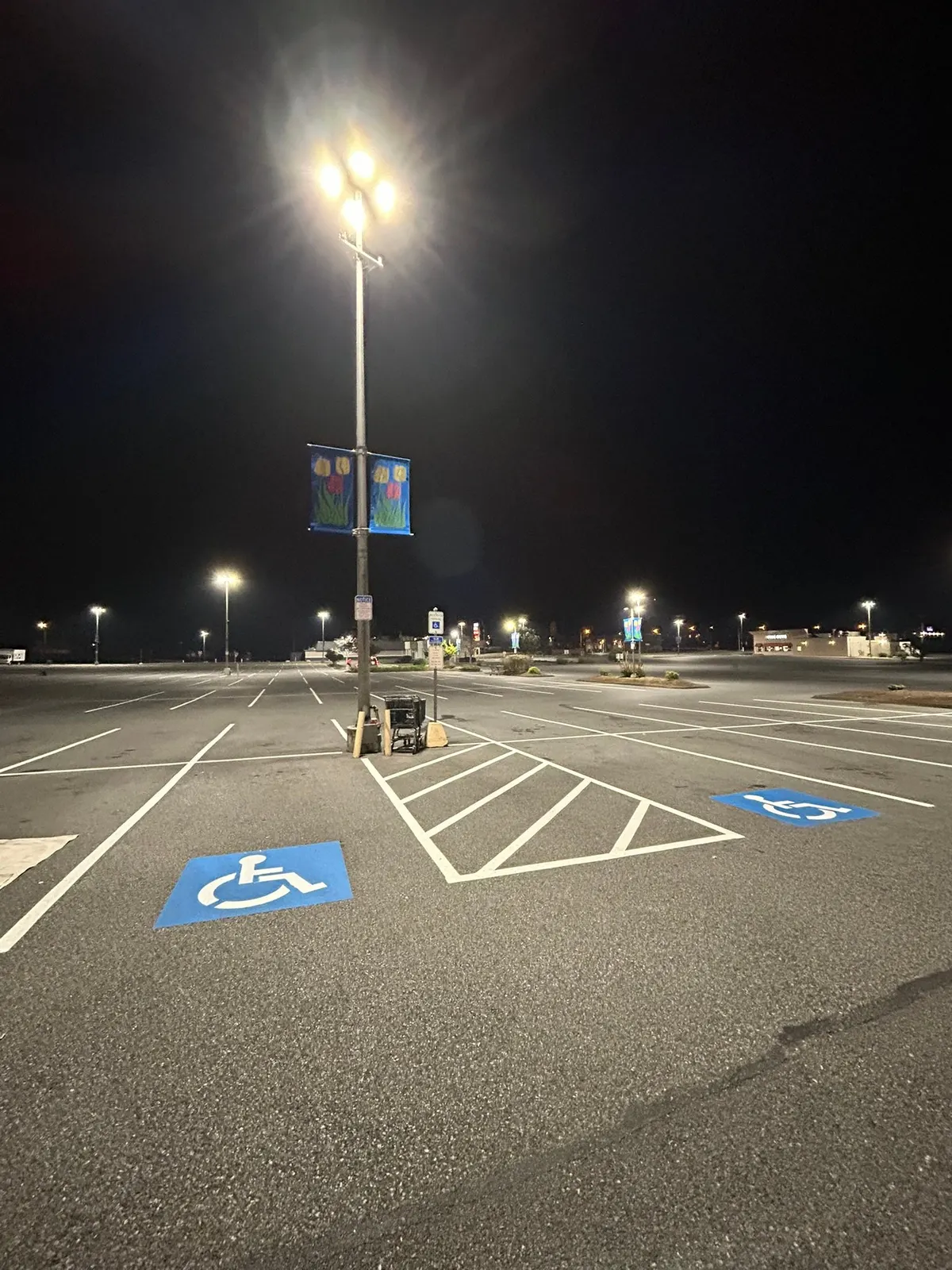
This is where most lots fail, because the numbers are specific and eyeballing doesn’t cut it:
- Standard accessible space: at least 96 inches (8 feet) wide, with an access aisle at least 60 inches (5 feet) wide alongside it.
- Van-accessible space, option one: a 132-inch (11-foot) wide space with a 60-inch access aisle.
- Van-accessible space, option two: a 96-inch space with a 96-inch (8-foot) access aisle, the extra width accommodates a wheelchair lift deploying from the side of a van.
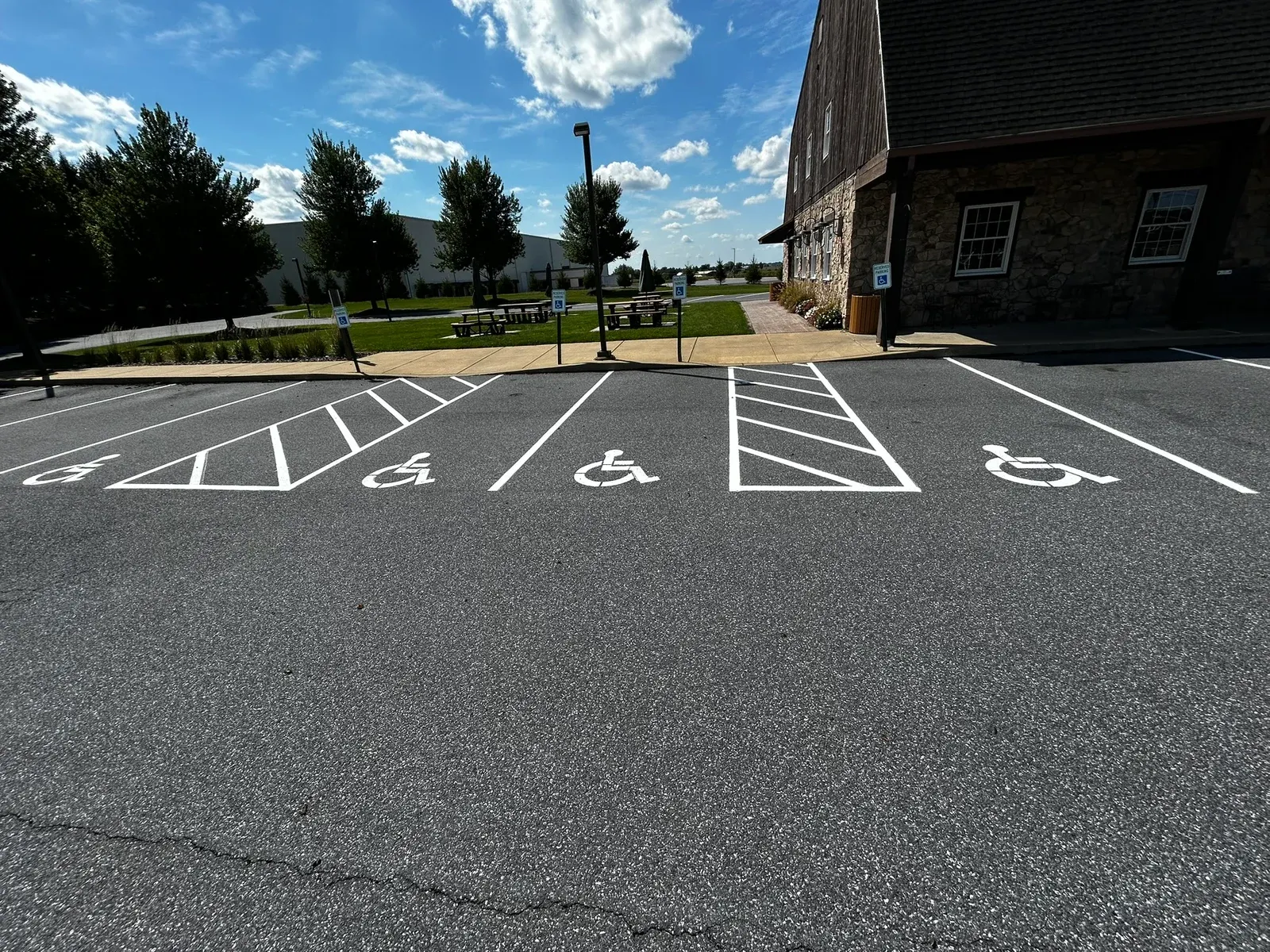
- Access aisles must be marked to discourage parking in them (crosshatching is the standard method), must be level, and must connect to an accessible route to the building entrance, not force someone to travel behind parked cars.
- Two spaces may share one access aisle. That’s a legitimate, space-efficient layout we use often.
One more detail that surprises owners: slope. Accessible spaces and their aisles can’t exceed a 1:48 slope (about 2 percent) in any direction. A space painted on a noticeable grade is non-compliant no matter how perfect the striping is, because a wheelchair user can’t safely transfer on a slope.
Signs: The Requirement Paint Can’t Satisfy
The painted symbol on the pavement is not enough by itself. Each accessible space must have a vertical sign displaying the International Symbol of Accessibility, mounted so the bottom of the sign is at least 60 inches above the ground, high enough that a parked vehicle can’t hide it. Van-accessible spaces need an additional “van accessible” designation on the sign. The one exception: lots with four or fewer total spaces must still provide an accessible space, but the sign is not required.
Why the sign requirement matters so much: pavement markings disappear under snow. In a Pennsylvania January, the sign is the only thing marking that space, which is exactly why enforcement treats missing signage as a serious violation, not a technicality.
Location: Closest Spaces to the Accessible Entrance
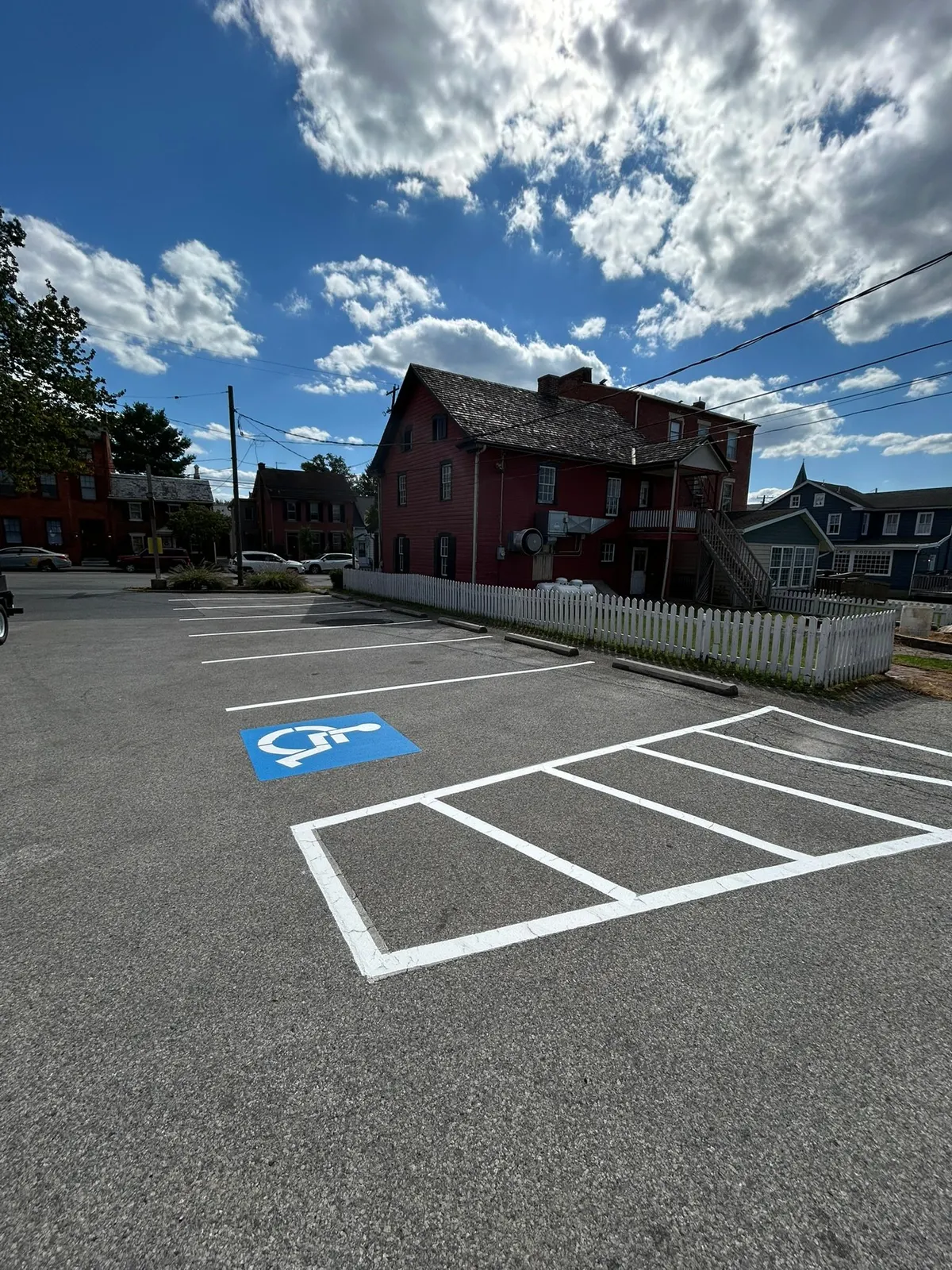
Accessible spaces must be located on the shortest accessible route to the building’s accessible entrance. You can’t tuck them at the far end of the lot because the geometry was easier there. If your building has multiple entrances, the spaces should be distributed to serve them. And the route from the access aisle to the door must be genuinely accessible, curb ramps where needed, no stairs, no gravel gaps. We flag route problems during layout because a perfectly striped space that dead-ends at a curb still fails.
What Non-Compliance Actually Costs in Pennsylvania
ADA parking violations are enforced two ways. The Department of Justice can pursue civil penalties, currently over $75,000 for a first violation and over $150,000 for subsequent ones. Far more common in Pennsylvania, though, are private lawsuits and demand letters. Serial plaintiffs check lots for exactly the items in this guide: missing van-accessible spaces, faded or absent aisle markings, low or missing signs. Settlements routinely run into the thousands, plus attorney fees, plus the cost of the fix you needed anyway.
Compare that to the remedy. Restriping accessible spaces, painting crosshatched aisles, and setting compliant signs is typically a few hundred to a couple thousand dollars depending on lot size, our striping work starts at a $400 minimum visit, and we do it nights or weekends so your business doesn’t close. As risk-reduction spending goes, it’s about the cheapest insurance a property owner can buy.
Compliance Is Ongoing, Not One-Time
A compliant lot can drift out of compliance without anyone touching it. Pennsylvania winters are the main culprit: plow blades scrape pavement markings, and two or three seasons of plowing can erase a crosshatched access aisle almost completely. A space with a faded symbol and an invisible aisle is treated as non-compliant, regardless of what it looked like when it was painted. Signs get hit by trucks, bent, or removed during other site work and never reinstalled.
The practical answer is to fold an accessibility check into your regular restriping cycle, for most commercial lots, every two to three years. It adds nothing to the mobilization cost, and it means your compliance documentation stays current. We photograph accessible spaces, aisles, and signage on every job, so if a claim ever does arrive, you have dated evidence that the lot met the standards.
Snow management belongs in this conversation too. A legally perfect accessible space that spends January buried under the plow pile is a barrier, and complaints about snow-blocked accessible parking are common. Tell your plow contractor where the snow can’t go; it’s a one-sentence instruction that prevents a real problem.
How We Bring a Lot Into Compliance
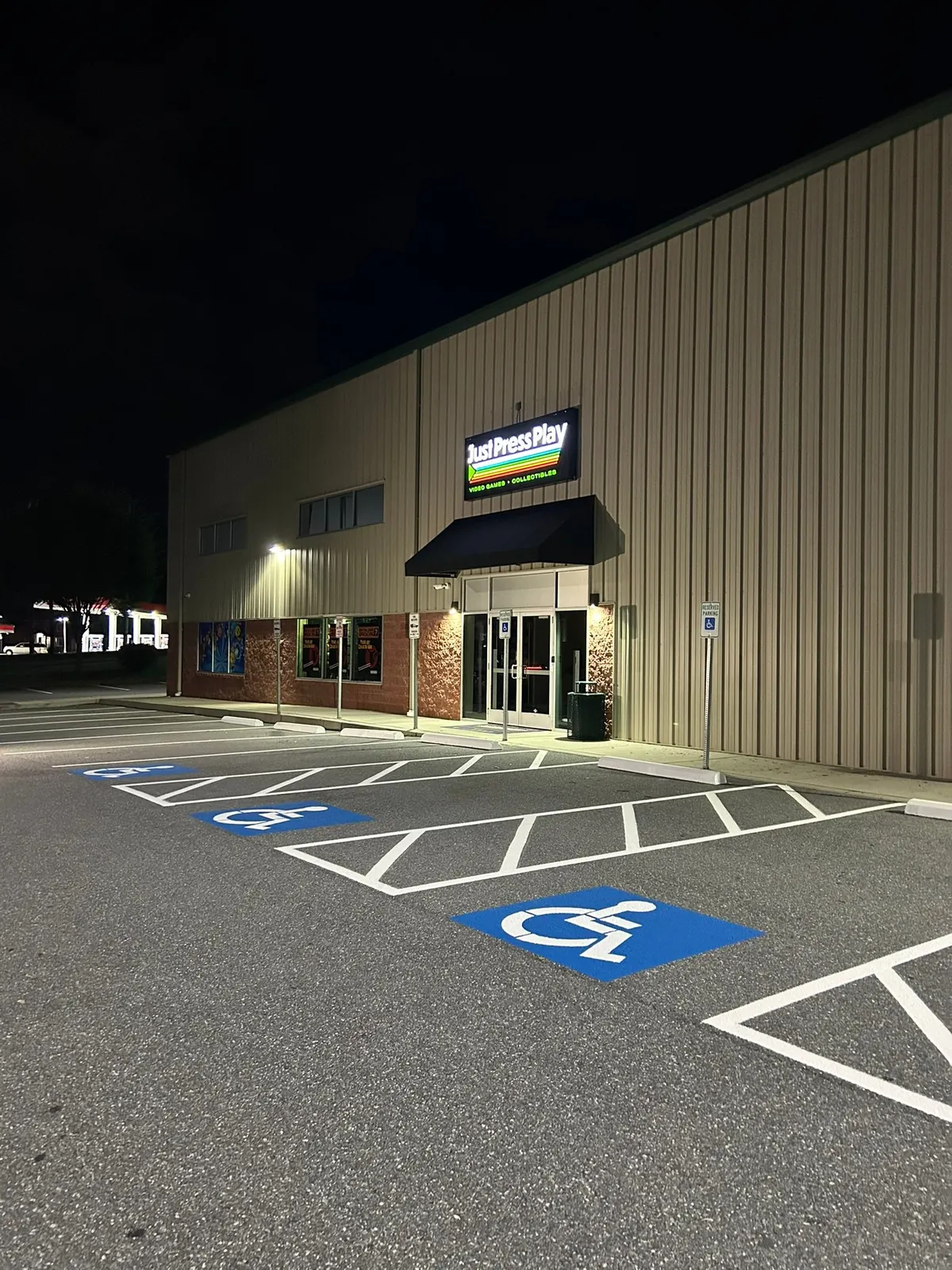
Our process is the same whether it’s a 20-space office lot or a shopping center: count the total spaces, calculate the required accessible count, verify dimensions with a tape measure, never by eye, check slope, then lay out the spaces with chalk lines before any paint goes down. Blue background fields go on first, white symbols and crosshatching after, and signage gets verified at 60 inches. You can see this applied on a real project in our write-up of ADA parking and loading zone striping for a commercial retail building in Lancaster County.
For a deeper checklist you can run on your own property, we also maintain a full guide to ADA parking lot requirements. And if your whole lot is due for fresh lines anyway, folding compliance work into a complete restripe is the most economical path, one mobilization, one night of work, one compliant lot.
This video shows accessible-space layout work on a commercial lot, useful context for what compliant striping looks like in progress:
Frequently Asked Questions
My lot was striped years ago. Am I grandfathered in?
No. The ADA requires barrier removal in existing facilities where it is “readily achievable,” and restriping a parking lot is the textbook example of readily achievable. If your lot predates the 2010 Standards, you’re expected to bring it up to current requirements the next time the lot is restriped, and plaintiffs’ attorneys know that. Age of the lot is not a defense; if anything, an old lot that has been repainted since 2012 without being corrected is a stronger case for the plaintiff, because the owner had the opportunity to comply and didn’t.
Does Pennsylvania add requirements beyond the federal ADA?
Pennsylvania enforces accessibility through its Uniform Construction Code, which incorporates accessibility standards closely aligned with the federal rules, and local codes can add signage details. The federal ADA numbers in this guide are your floor everywhere in the state. When local rules differ, the stricter requirement wins, we check both during layout.
What color does an accessible space have to be?
The federal standards actually don’t mandate blue paint, they require the spaces and aisles to be marked and the vertical sign to be present. Blue with the white symbol is the universal convention and what inspectors and the public expect, so that’s what we install. The crosshatched aisle marking, however, is effectively required, since aisles must be marked to discourage parking.
Can I lose spaces by adding accessible parking?
Usually one or two, sometimes none. Because two accessible spaces can share a single access aisle, a thoughtful layout often converts three standard stalls into two compliant accessible spaces. On most lots we can rework the row nearest the entrance with minimal loss, that’s a layout problem, and layout problems are solvable.
How fast can compliance work be done?
For most Lancaster County lots, one visit. We measure and quote for free, then complete the striping, symbols, and crosshatching overnight or on a weekend. Waterborne traffic paint takes traffic within hours, so the lot opens on schedule the next morning. We handle this work throughout the county, including Strasburg and the surrounding townships.
Check Your Lot Before Someone Else Does
Walk your lot with this guide, or skip the tape measure and let us do it: we’ll assess your accessible spaces, aisles, signage, and counts at no charge, and quote exactly what compliance takes as part of our line striping service. Contact us online or call 717-808-1600. A compliant lot protects your customers and your business, and it’s one of the few legal problems that can genuinely be solved with paint, done right, in a single night.