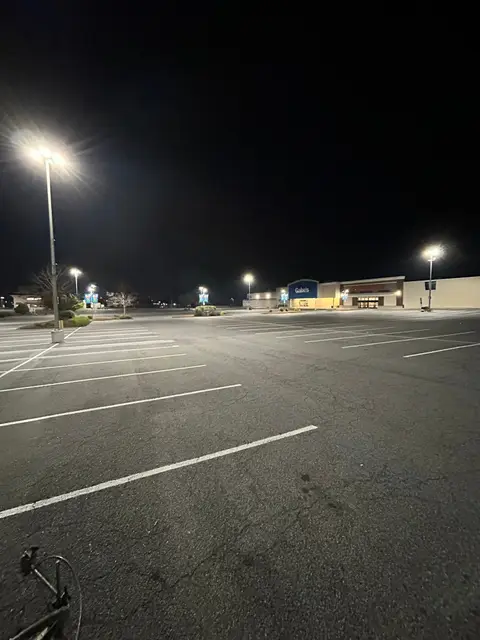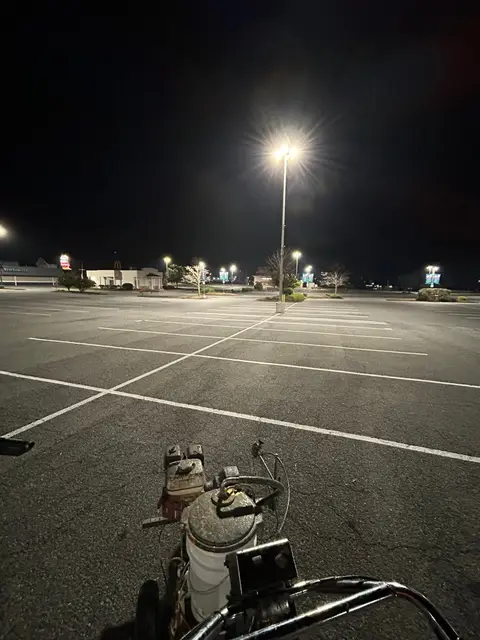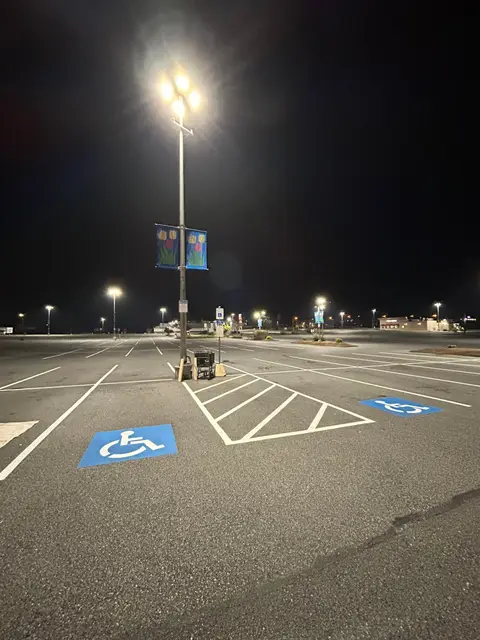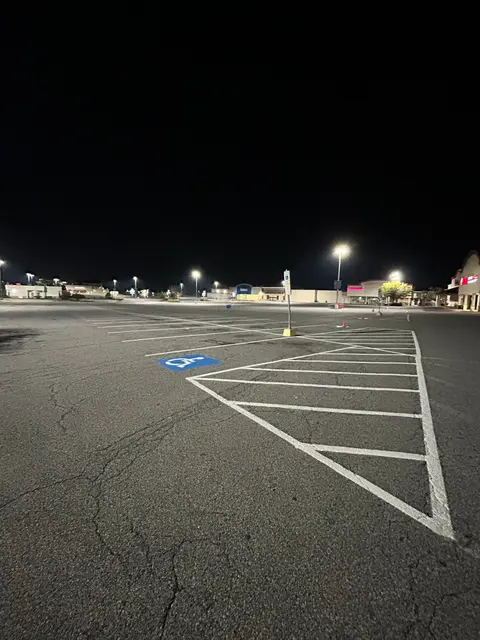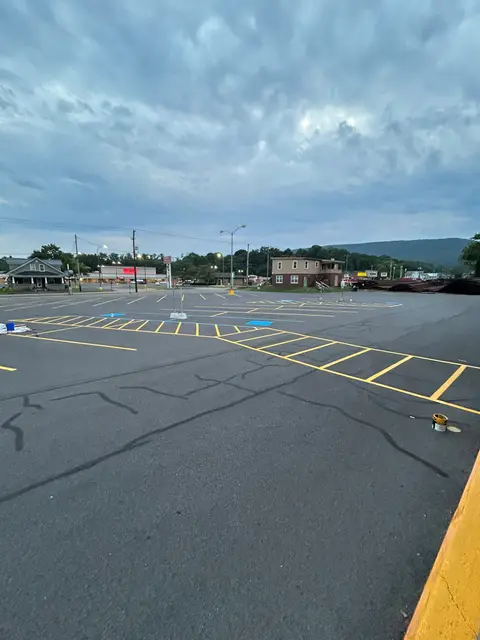
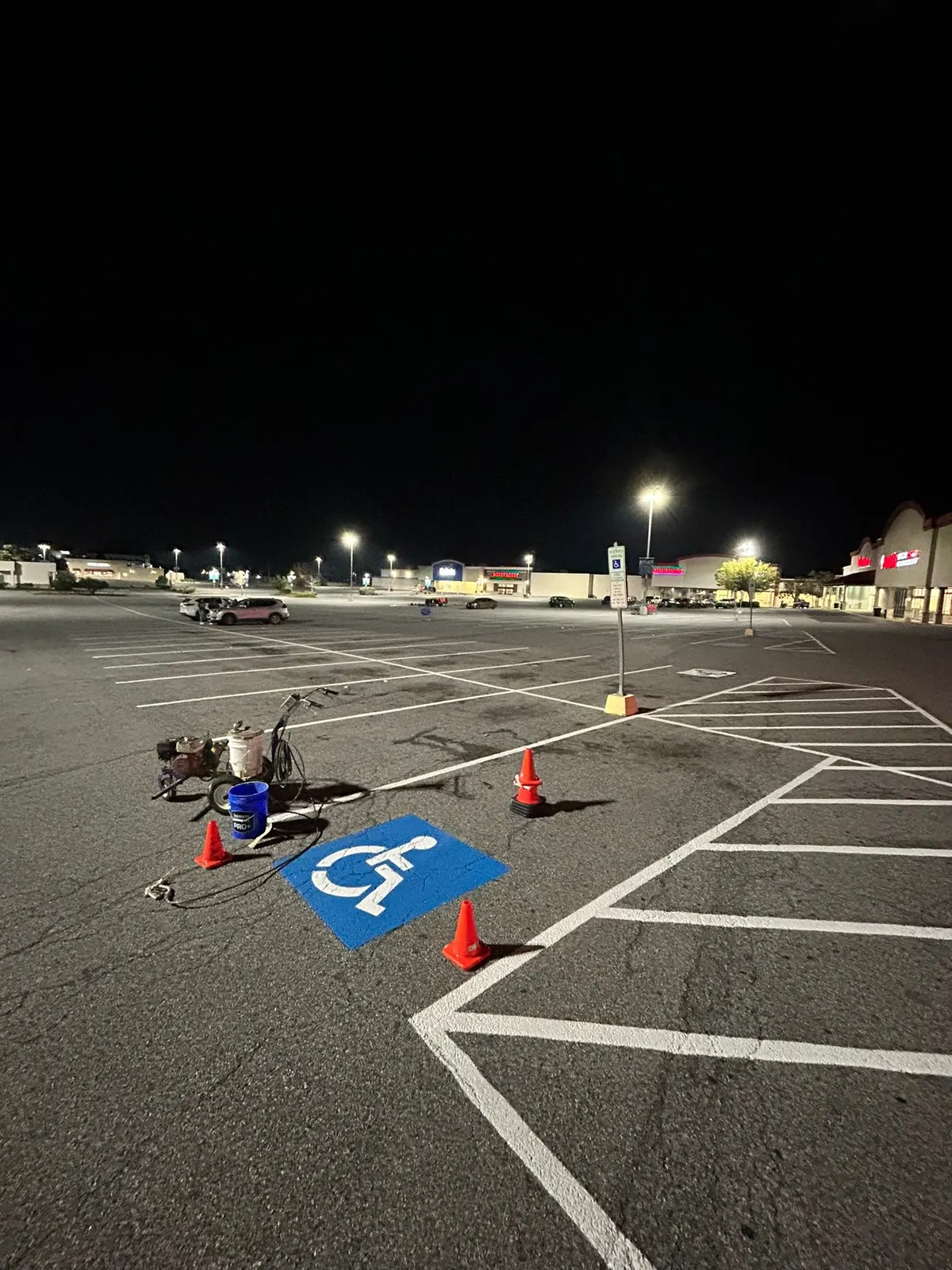
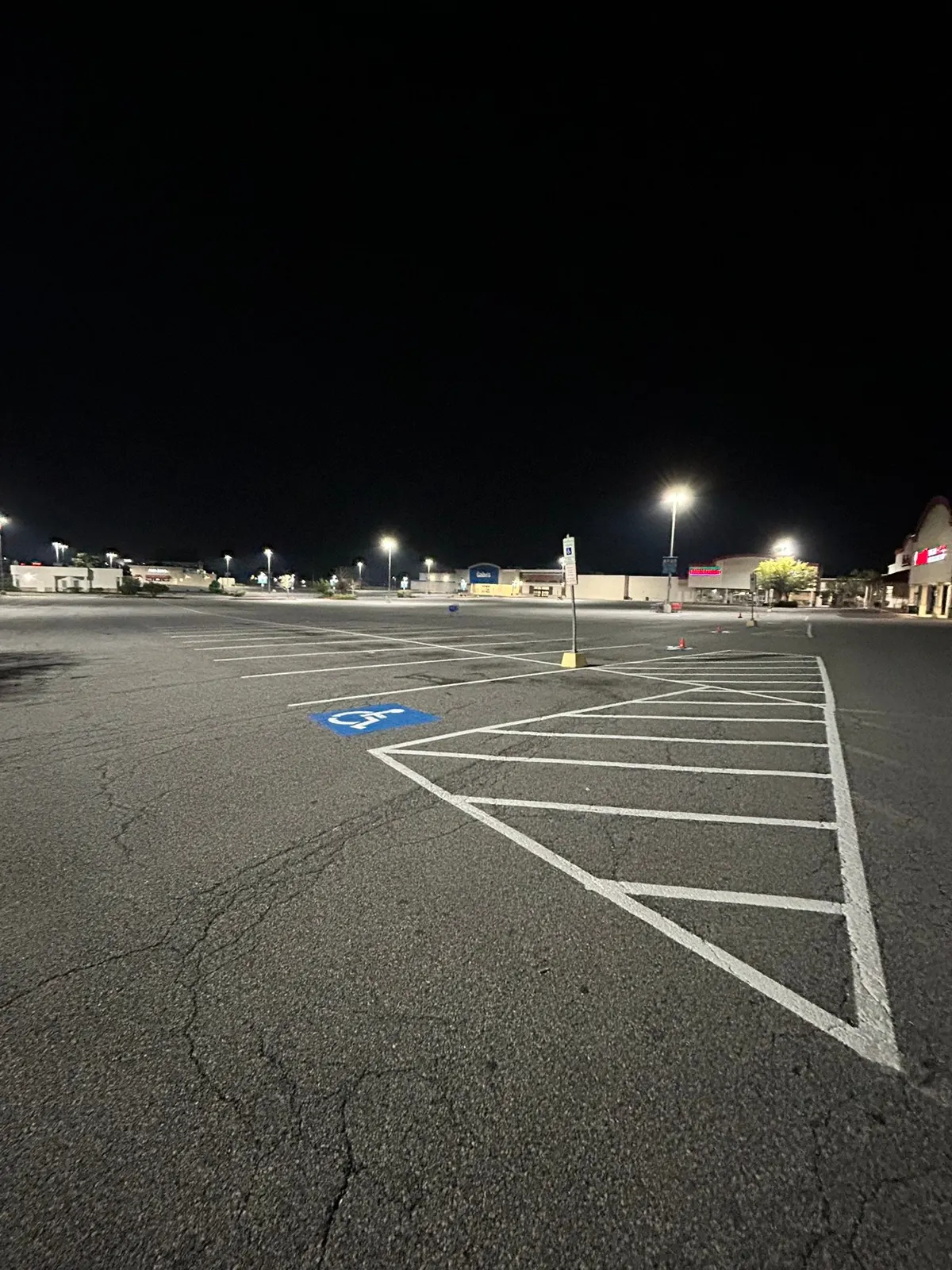
If we are doing a retail lot right, you never see us do it. This shopping center is a good example. Several tenants share one large lot, the stores are open all day and into the evening, and there is no hour when closing the lot would not cost somebody business. So we did the whole job at night, under the lot lights, after the last store locked its doors.
Why night work
Daytime striping on a retail lot means cones, closed rows, customers hunting for a space and tenants calling the property manager. Night work avoids all of that. The lot is empty, we can work in long uninterrupted runs, and the paint has hours to cure before the first car arrives. The lot lights at a shopping center are bright enough to work by, and we bring our own lighting for the detail work on stencils and symbols.
The trade off is that everything has to be planned in advance. There is no time to figure out the layout at 11 p.m. We walked the lot during the day, measured, counted the stalls, checked the accessible stalls against the current ADA standards, and confirmed the plan with the property manager before the night of the job.
The condition of the lot
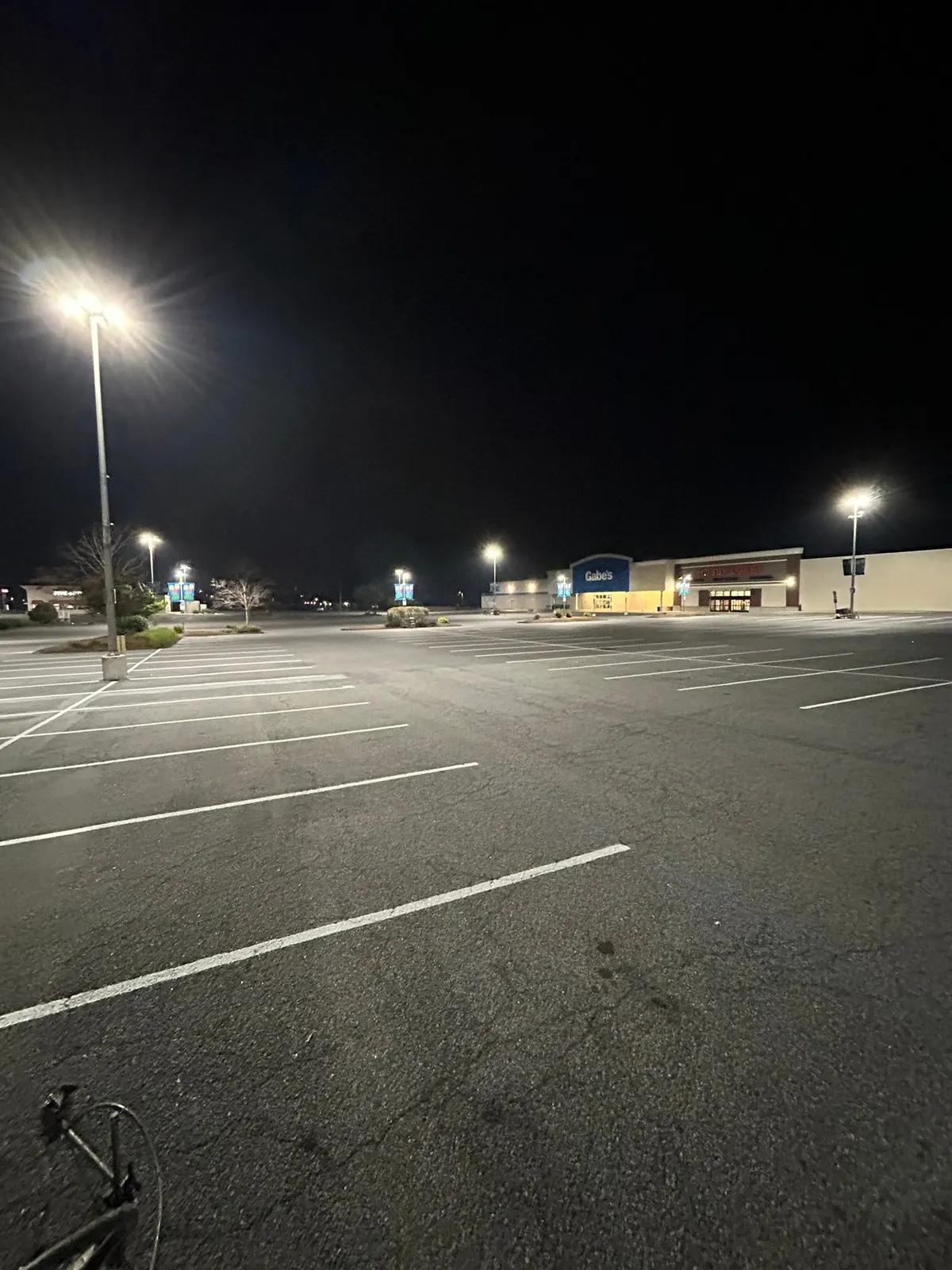
The old lines had worn down to ghosts in the drive aisles and the front rows, where the traffic is heaviest. Away from the storefronts they were still visible but faded. The accessible stalls were the most important thing to fix: a faded blue stall with a worn symbol is treated as non compliant whether or not it was correct when it was painted.
Re-striping the stalls
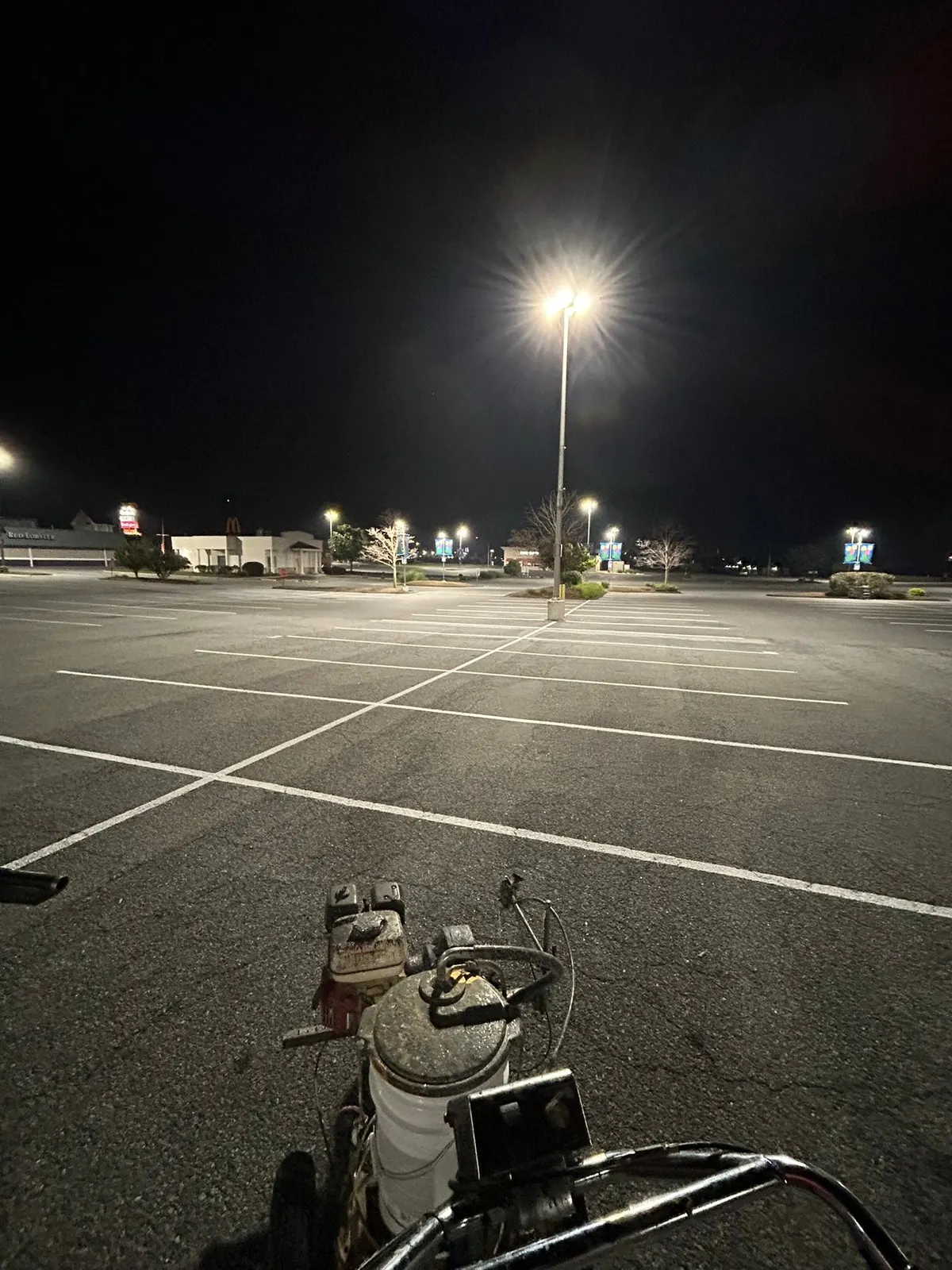
The lot was re-striped in white. We followed the existing layout where it was correct and tightened up the places where previous crews had let the lines drift. Every line went down with the striping machine for consistent width, and every start and stop was clean. On a lot this size, the difference between a careful re-stripe and a quick one is visible from the road the next morning.
Accessible stalls that pass inspection
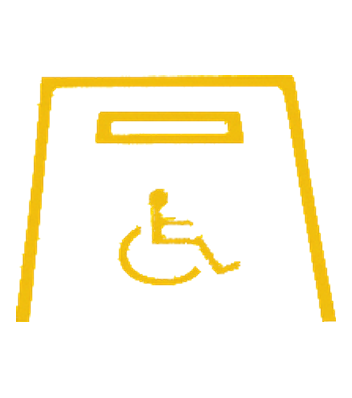
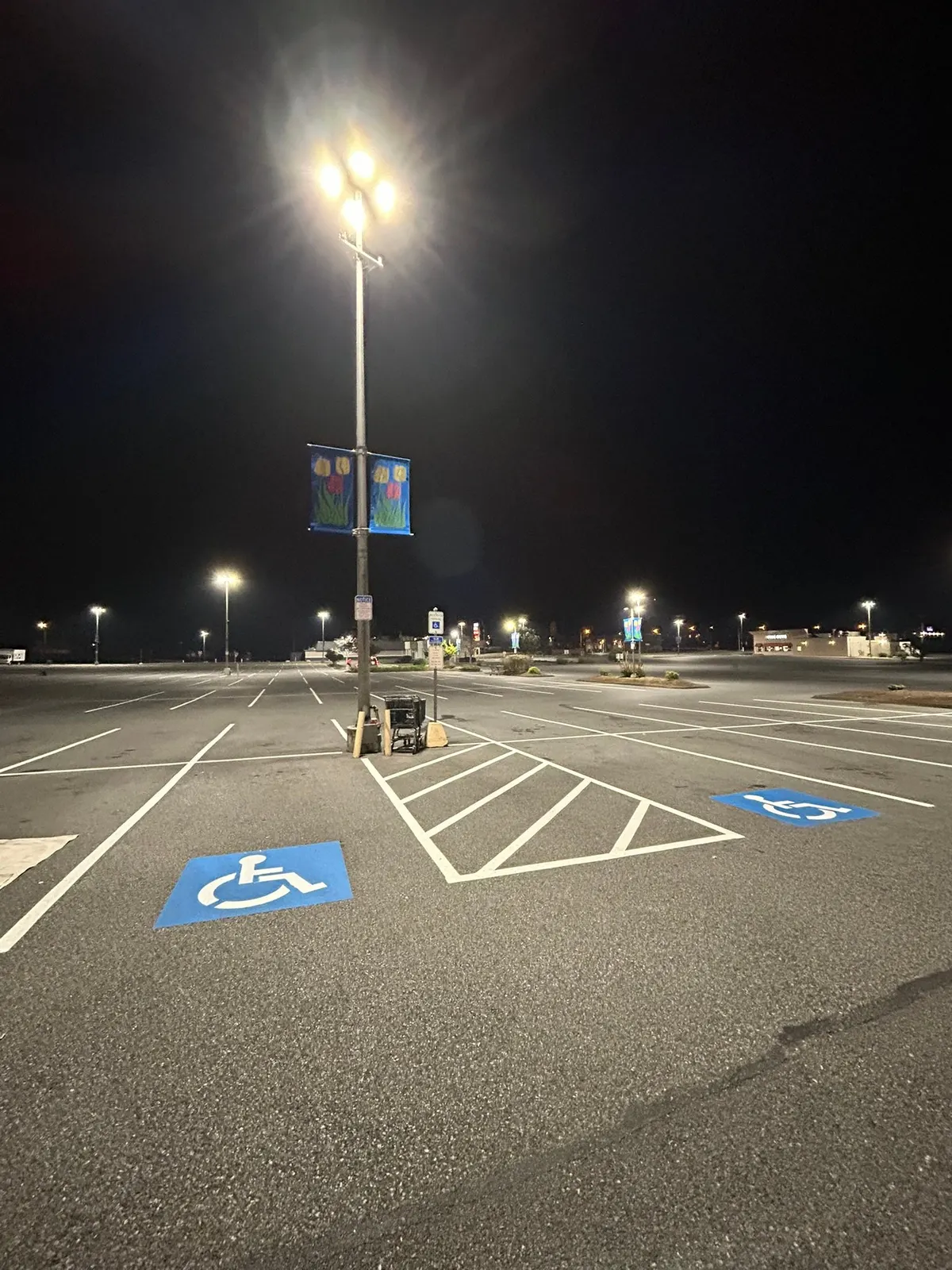
The accessible stalls were done as a set: a full blue background with the white symbol of access centered in the stall, and a hatched access aisle beside each one. The aisle hatching was laid out with chalk first so the diagonals are evenly spaced and the outline is square.
Two things we always check on a shopping center:
- The count. The number of accessible stalls required depends on the total number of stalls in the lot. A lot that has grown over the years sometimes has fewer accessible stalls than it needs. We count before we paint.
- Van accessible stalls. At least one of every six accessible stalls has to be van accessible, which means a wider stall or a wider aisle. We confirm that the layout allows for it.
Signs are part of the requirement too. We do not install signs, but we tell the property manager what each stall needs so the sign company can finish the job.
The timeline of a night job
A typical overnight stripe on a shopping center runs like this:
- Evening. We arrive as the last stores close and cone off the entrances to the rows we will paint first.
- Layout check. Chalk lines go down where the layout changes or where the old lines are too faded to follow.
- Stall lines. The machine runs the long lines row by row. This is the bulk of the night.
- Stencils and symbols. ADA symbols, arrows and any stencils are painted by hand once the lines are down.
- Cure. Water based traffic paint is dry to the touch within an hour in good conditions and continues to harden overnight.
- Walk through. Before we leave, we walk the whole lot with a light, checking every line and symbol, and pick up every cone.
By the time the first employees pull in, the lot looks like it was painted a week ago.
What the property manager got
- A fully re-striped lot with no daytime closure and no tenant complaints.
- Accessible stalls that meet the current standard, with the symbol and aisle clearly visible.
- A clean lot in the morning, with no cones, no overspray and no tracked paint.
When night work is the right choice
Night striping makes sense for retail, restaurants, medical offices with daytime patients, and any lot where closing rows during the day would be a problem. It costs a little more in planning and labor than a daytime job, and the paint needs cool, dry conditions, so we watch the overnight temperature and the dew point. In the warm months, a clear night is close to ideal for traffic paint.
For churches, schools and offices, daytime work on a quiet day is usually easier. We will tell you which approach fits your property when we look at it.
What we check before a night job
Night striping only works if the thinking is done in daylight. Before this job we went through the same list we use on every overnight lot.
- Stall count and accessible stall count. Counted on site, compared with the ADA table, and confirmed with the property manager.
- Layout corrections. Any rows where the old lines had drifted were measured and marked for correction.
- Stencils and symbols. A list of every arrow, symbol and stencil, so nothing is forgotten at 1 a.m.
- Lighting. Which parts of the lot the pole lights cover well and where we need our own lights.
- Closing times. When the last store locks up and when the first employees arrive, which sets the window we have.
- Weather. Overnight temperature, humidity and dew point, and the chance of rain.
Weather and night paint
Traffic paint behaves differently at night. The air is cooler and the humidity is higher, so paint dries more slowly than it would at noon. The surface temperature has to stay above about 50 degrees, and the dew point matters: if the pavement temperature drops to the dew point, moisture condenses on the surface and the paint will not bond. We check the forecast for the night and the pavement temperature on site, and we reschedule if the numbers are wrong. In the warm months, a clear night with a light breeze is close to perfect for striping.
Who night work suits
Night striping is the right call for:
- Retail plazas and shopping centers with daytime customers.
- Restaurants, which are busiest in the evening and empty after closing.
- Medical and dental offices with daytime patients and accessible stalls that cannot be closed.
- Grocery stores and pharmacies with long hours.
- Any lot where closing even a few rows during the day creates complaints.
Offices, churches and schools usually do better with daytime work on a quiet day. There is no reason to pay for a night crew when the lot is empty on a Tuesday.
Questions property managers ask about night striping
Is night work more expensive?
Somewhat. It takes more planning and the crew works unusual hours. For a retail lot, that is almost always cheaper than losing customers to closed rows during the day. We price each job on its own.
How do customers know the lot was painted?
In the morning, the lines are bright, the cones are gone and the paint is dry. Most customers never know a crew was there. If a few stencils are still curing at opening, we leave cones on those stalls only.
What if it rains during the night?
We do not start if rain is likely. Fresh paint hit by a downpour streaks and has to be redone. If a surprise shower arrives mid job, we stop and come back.
How long before the lot can open?
Water based traffic paint is dry to the touch within about an hour in good conditions and continues hardening over the next day. A lot painted overnight is fully ready for traffic by morning.
Do you paint the ADA signs too?
We paint the stalls, aisles and symbols. Signs are a separate trade, and we tell you what each stall needs so the sign company can finish the job. The full rules are in our guide to ADA parking compliance in Pennsylvania.
Details
- Shopping center parking lot with multiple tenants, re-striped in a single overnight shift.
- White stall lines over the existing layout, corrected where earlier lines had drifted.
- Blue ADA stalls with the white symbol of access and hatched access aisles.
- Layout checked and confirmed during the day, painted at night, open to customers in the morning.
Lancaster Lines & Asphalt stripes commercial lots across Lancaster County and the surrounding area, by day or overnight depending on what your property needs. See the parking lot striping page and the ADA parking markings page, or request a free quote.